


 |
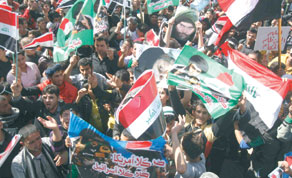
| Supporters of Shia cleric Moqtada al-Sadr wave Iraqi flags and portraits of al-Sadr during a rally in Basra yesterday |
Up to a million followers of Iraqi cleric Moqtada al-Sadr took to the streets yesterday in a massive show of force before an Arab League summit which Iraq’s long-oppressed Shia majority view as their debut on the regional stage.
The protest in the southern city of Basra marked the anniversary of the start of the US invasion in 2003. Slogans were mainly directed at the government of Prime Minister Nuri al-Maliki for failing to improve the lives of Iraq’s poor.
But the main context appears to be the March 27-29 Arab League summit, the first in Iraq in more than 20 years and the first ever hosted by a mainstream Shia Arab ruler.
Basra police estimated the size of the crowd at between 700,000 and 1mn. A Reuters correspondent on the scene said it was clear at least several hundred thousand were there.
Sadr’s followers frequently hold demonstrations denouncing Sunni rulers of other Arab states for cracking down on Shia protesters in Bahrain last year.
Yesterday’s demonstration, by contrast, seemed to show a deliberate effort to avoid antagonising Arab neighbours by channelling protesters’ anger into domestic grievances.
There is no shortage of such outrage in a country where oil wealth has yet to alleviate dire poverty. Nine years after the invasion that toppled Saddam Hussain - a Sunni who oppressed Shias - most Iraqis have electricity only a few hours a day.
Men and women travelled from across Iraq to protest bearing Iraqi flags and portraits of Sadr. They carried black caskets labelled ‘Electricity’, ‘Education’ and ‘Democracy’.
“We came to call for the removal of injustice against Iraqis ... There are no jobs. We are living in bad conditions without services,” said Latiaf Kadhim, who came hundreds of miles from Karbala to participate in the demonstration in Basra.
Muttashar Saeed, who had travelled from Baghdad’s Sadr City neighbourhood, said: “Lawmakers are looking out for themselves while the state ignores the poor. We want the attention of officials who are busy with their own affairs in their comfortable chairs and armoured vehicles.”
Although the rhetoric has an internal target, such a massive show of Shia power highlights the awkwardness for some Sunni Arab neighbours in embracing Baghdad, which after Saddam’s fall became the Arab world’s only mainstream Shia-led state.
All the leaders at next week’s summit will be Sunni Muslims except Maliki. Syria’s Bashar al-Assad, a member of the small Alawite minority sect, is not invited because the Arab League suspended the membership of Damascus.
Sadr, who led uprisings against the US presence before American troops withdrew last year but is now a key member of Maliki’s ruling coalition, has banned protests during the summit to show “hospitality” to the guests.
Holding yesterday’s protest in Basra rather than Baghdad helps Maliki’s assertion that the capital is safe for the summit.
Authorities in Baghdad took no chances yesterday, imposing a security operation with checkpoints conducting thorough searches that snarled morning rush-hour traffic for hours.