


 |
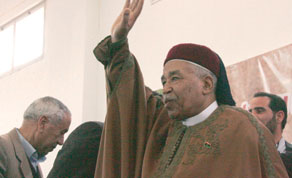
| Ahmed Zubair al-Senussi, a member of Libya’s ruling National Transitional Council, waves after being elected leader of the Cyrenaica region at a meeting yesterday in Benghazi |
Civic leaders in Cyrenaica, home to most of Libya’s oil, have created a council to administer the eastern region, a move that could lead to confrontation with the interim leadership in Tripoli.
About 3,000 delegates at a congress yesterday in the eastern city of Benghazi installed Ahmed al-Senussi, a relative of Libya’s former king and a political prisoner under ousted leader Muammar Gaddafi, as head of the new council.
Yesterday’s declaration tapped into long-standing unhappiness in the east of Libya at what it regards as neglect and marginalisation by the rulers in the capital, more than 1,000km to the west.
Moves towards greater autonomy for Cyrenaica may worry international oil companies operating in Libya because it raises the prospect of them having to re-negotiate their contracts with a new entity.
The declaration in Benghazi, cradle of the uprising last year which ousted Gaddafi, does not carry legal force.
It did not make clear whether the new provincial council would exist within the National Transitional Council (NTC)’s institutions, or be a rival to it.
Asked to clarify that point, Mohamed Buisier, one of the organisers of yesterday’s congress, said: “I’ve been in contact with people in Tripoli and I told them ‘come here and negotiate’... It should be through negotiation.”
But he added: “We are not going to give anyone a blank cheque.”
A member of staff who answered the phone at Benghazi-based Arabian Gulf Oil Company (Agoco), Libya’s biggest state-owned oil firm, said the 3,000 employees had been deliberating about whether or not to back the autonomy declaration. “Some people are in favour and some people are against but there is no official stance yet,” the Agoco employee said.
The declaration of autonomy adds to the challenges of the NTC, which has struggled to impose its authority on the country. Towns and militias run their own affairs with little reference to the government in Tripoli.
The eight-point declaration adopted in Benghazi said the “Cyrenaica Provincial Council is hereby established ... to administer the affairs of the province and protect the rights of its people”.
It said, though, that it accepted the NTC as “the country’s symbol of unity and its legitimate representative in international arenas.”
The declaration said the province wanted a federal system under which the historic provinces of Cyrenaica, Fezzan in the south and Tripolitania in the west of Libya would have a large degree of autonomy from the government in Tripoli.
It also rejected the mechanism for electing a new national assembly in June, saying it wanted greater representation for Cyrenaica.
Supporters of autonomy for Cyrenaica are seeking to recreate the system in place during the early rule of King Idris, Libya’s first post-independence ruler who was ousted by Gaddafi in a 1969 military coup.
During that period, Libya was run along federal lines. Cyrenaica enjoyed kudos and influence because the monarch’s family had its power base in the east.
People in eastern Libya complain they were sidelined during Gaddafi’s 42-year rule and did not receive a fair share of the country’s energy wealth.
Those complaints have become more vocal since Gaddafi was forced out in last year’s rebellion.
“This step (declaring autonomy) has been taken by families who in the past had prestige and think that if they do this they can return to the past,” said Suleiman Khalifa, an official with National Democratic Current, a political party.
Al-Senussi, the head of the self-declared Cyrenaica council, is the great nephew of King Idris. Gaddafi put al-Senussi in jail after he tried to stage a coup d’etat in the early 1970s. He stayed in prison until he was pardoned in 2001.
Last year the European Parliament named al-Senussi, now a member of the NTC, as one of the winners of its annual Sakharov Prize for Freedom of Thought.
Several Libyan cities, including Benghazi, have witnessed rallies rejecting the federal system of government, with banners and slogans emphasising national unity and state-building, and stressing that Tripoli is the only capital.
Senior officials in Tripoli, including interim leader Mustafa Abdel Jalil and interim Prime Minister Abdel Rahim al-Kib, have flatly rejected the federalist project, promoting a programme of decentralisation instead.
Abdel Jalil said on Monday night that calls for the implementation of a federal system did not represent a major source of concern to his government because “Libyans fought for a united Libya.”
During the programme ‘Meet the Minister’ broadcast on state TV on Monday, Kib flatly rejected calls to fashion Libya into a federation.
“We do not need federalism because we are heading towards decentralisation and we don’t want to go back 50 years,” he said without elaborating.
His address came after the interim government held an emergency session on Sunday to discuss a bill proposing the principle of decentralisation. More than 50 local councils are reviewing the project, Abdel Jalil said.
In Tripoli, interim Interior Minister Fawzi Abdelal said yesterday the interim government so “no reason” for federalism in Libya. “We have no reason for federalism because Libya does not group different peoples or religions,” he said, adding that this type of government is not always successful.
Kib on Monday urged his nation’s “silent majority” to protect the state against “pseudo-revolutionaries.”
“There must be solidarity between the government and the people,” Kib said.
“It is up to the silent majority to protect the institutions of the state, to fight chaos, to say no to those who usurp state property and territory, to reject non-state institutions,” he said.
Kib said he did not want “new blood to be spilled” in Libya but that it was up to the street to “fight against the chaos” taking place in the country.
Rights groups warn that out of control militias pose the greatest challenge to stability in the north African nation which is seeking to build state institutions from scratch after decades of dictatorship.
Many sensitive sites, including the Tripoli airport and official buildings, remain under the control of so-called revolutionary brigades, who battled former regime forces until Gaddafi was captured and killed in October.
Kib criticised the registration of more than 140,000 people with the committee of veteran affairs, saying the number was an exaggeration, and calling on “true revolutionaries” to help build state institutions.
He also announced that the government is in the process of establishing offices in Benghazi and Sabha to the south which, he said, will help facilitate the administrative transactions of citizens.