


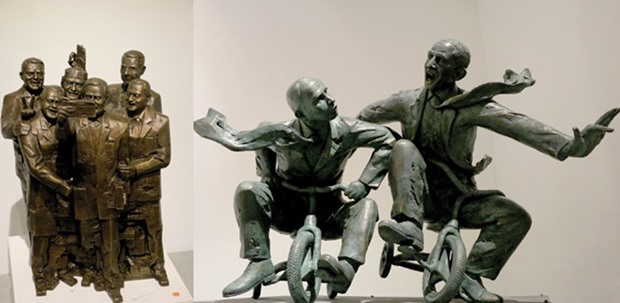
The animal features prominently in his latest exhibition of artwork, ‘What if’, recently gone public at Katara Art Centre (KAC) and open until April 15. Containing his trademark statues of fibreglass, metal and bronze, the exhibit reflects the Doha-based Iraqi artist’s abhorrence for war and violence.

MESSAGE: Ahmed al-Bahrani wants the world to shun violence and move towards peace.
His ideas are profound, executed with artistic majesty that very few artist can achieve in his medium. One piece, for instance, is a whole army of white fibreglass donkeys marching in one direction with a tank on their back, facing the other direction.
By placing them in different directions, the artist is questioning the human norms and the influence through authority. He seeks for an urgent action, for the world to unite against conflicts.
“The donkey is a very smart animal. It hates violence and war. I used to live in a farm in Iraq and we had a lot of donkeys there. And I guess that is how it influences some of my work,” the artist tells Community.
He has been away from his country for 22 years. There have been combined factors of war and violence and the economic problems that forced him out of his country and he detests war.
“My art pieces are a reflection of my thoughts and I believe everybody should hate war. Why are people being killed?” says al-Bahrani.
“Art comes to me naturally. I believe I was born an artist. I was destined to do this. My message is that of love for the whole world. Regardless of race, religion, ethnicities or colour of skin, people from across the world need to love each other and live in peace,” says the artist.
Al-Bahrani is internationally renowned for having created thought-provoking large-scale sculptures in the past, such as a gun-toting Mother Theresa, and often bases the themes of his works on past experiences, such as war and exile.
The theme of his exhibition at KAC revolves around the idea that the connection between people’s humanity has become somewhat detracted and detached from the increasingly atrocious acts that comes from the conflicts of war.
People, both as individuals and collectively as a society, have the untapped and limitless potential to impact and make drastic changes needed to heal the world; however, presently this is overlooked and instead we tend to dispute amongst ourselves and go against each other.
We are at war with each other, and the blood of the innocent is spilled for the gain of only a few, says the artist.
Al-Bahrani’s reflection on war comes as no surprise — growing up as an Iraqi from Babylon, he sought an answer that could end war.
He is one of the many Iraqis who left their country for a new beginning and today he demonstrates his stands on war, portrayed through the distinct aspect of art that has provoked him into challenging the audience.
Al Bahrani uses bronze and metal to create the unique sculptures that carries out the outspoken statements, which can be seen from his previous exhibition ‘War to War’ in Miami.
In fact, through the ‘What If’ collection of 2015, he illuminates the art work as a sense of memory, present reminders and future endeavours. One of the collection’s main sculptures is a piece that speaks on behalf of the suffering regions of the world.
Born in 1965 in Babylon, Iraq, al-Bahrani obtained a diploma in art from Fine Arts Institute, Baghdad in 1988 and currently lives between Doha, Qatar and Stockholm, Sweden.
Ahmed al-Bahrani was inspired to sculpt from childhood, when he created works out of mud in the Euphrates River that were then dissolved and claimed by the river itself. In that way, al-Bahrani proclaims that sculpture chose him, and not the other way round.
His work has departed from the traditional scope of structure that was prevalent in Middle Eastern sculpture to attain a minimalistic quality that is characterised by both clarity and simplicity. His individualistic approach has resulted in creating a sense of flexibility and movement to an otherwise heavy and rigid material.