



DEDICATION: Cai Guo-Qiang has devoted three years to the curatorial research and development of the exhibition.
For some, the Chinese escape artists’ high-impact art installation featuring a high-pressure hydraulic pump, fire hose, hydrant, and an electronic control system, might speak of the merciless wrath of nature, and for some, the wildly flailing fire hose symbolises a sense of liberation, which is perhaps where it earns its title ‘Freedom’ from. The modus operandi of Yuan and Yu’s Freedom, as with their most other works, is “structurally analogous to a disappearing act that succeeds by not happening.”
Freedom is one of the several delights that are in store at the brand new and a very ambitious exhibition by Qatar Museums (QM), ‘What About the Art? Contemporary Art from China’. Featuring the works of 15 contemporary Chinese artists curated by the internationally acclaimed New York-based Chinese artist Cai Guo-Qiang, the exhibition that opened yesterday will run until July 16 at the QM Gallery Al Riwaq.
A major highlight of the Qatar China 2016 Year of Culture, the exhibition is the melting pot of contemporary Chinese artists and collectives born in Mainland China working in a variety of media: Jenova Chen, Hu Xiangqian, Hu Zhijun, Huang Yong Ping, Li Liao, Lian Shaoji, LIU Wei, Liu Xiaodong, Jennifer Wen Ma, Sun Yuan & Peng Yu, Wang Jianwei, Xu Bing, Xu Zhen, Yang Fudong and Zhou Chunya. Following the great success of his solo exhibition ‘Cai Guo-Qiang: Saraab’, held at Mathaf in 2011, Cai Guo-Qiang returns to Qatar, this time as a curator, to present this large-scale exhibition.
Having devoted three years to the curatorial research and development of the exhibition, Cai Guo-Qiang has taken great pains to ensure that the artworks exemplify each artist’s unique artistic language and methodology. The artists have poured their hearts out in the diverse bodies of works that are on display and traverse the media of painting, sculpture, installation, video, performance and interactive video game design.
Attesting to the artists’ focus on artistic value and originality, there’s Liang Shaoji who uses live silkworms that change the artwork with time as they wrap their silk around the objects throughout the show. Interestingly, although Shaoji is the artist, it’s the silkworms he breeds that “create” the art.
Shaoji, who for years has observed silkworms making silk the entire night through, says in a book that serves as a companion reader to the exhibition, “I used to watch them work. At one point, I fell asleep for about two hours and a silkworm fell on my neck. When I woke up, I found a thin layer of silk on my neck. Afterward I thought: I am a silkworm myself. I could do this on a huge scale.”
By channelling the habits and movements of silkworms – they like climbing high places and if they fall down making silk, they climb again – Shaoji has created several eye-arresting pieces such as the magical raw silk strands-coated one on display, Moon Garden. It is an ode to the rise and fall of the ancient civilisations of the Fertile Crescent, and to the present condition of the region, two curving acrylic sheets echo the shapes of winding rivers, while within the silk pattern, one can make out the Arabic word for serenity.

Sun Yuan & Peng Yu, Freedom, 2009.
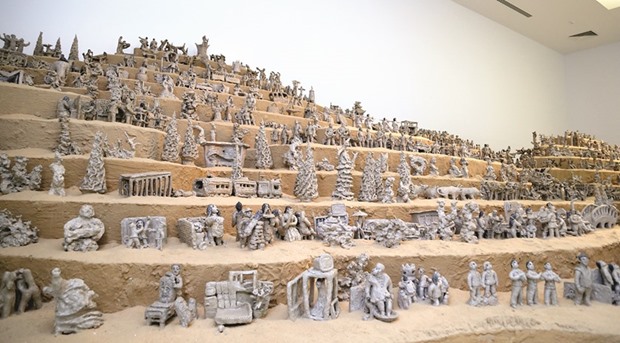
Then there are some striking pieces such as Liu Xiaodong’s paintings created on site, part of which is the portrait of the former Minister of Culture’s family representing three generations, a heretofore-unprecedented depiction of a local family by a foreign artist. The range of works on display stretches with the sculptural comic book created by the 65-year-old peasant artist Hu Zhijun using nearly 600 clay sculptures on a terrace-field of sand, and celebrated expatriate artist Huang Yong Ping’s six-tonne giant ‘sea monster’ Wu Zei that is featured in the central circular 22-metre gallery hovering above ground.
Since critical reception of contemporary Chinese art has largely been grounded in narratives of Chinese history and culture, focusing on the art market and the artworks’ socio-political context, Cai Guo-Qiang has decided to display a selection of artworks being created by Chinese artists today, with the goal of underlining the individual pursuit of creativity within contemporary Chinese art, and further to re-direct the world’s attention to art and practice.
As Cai Guo-Qiang says in the exhibition book, “This exhibition is not a retrospective of contemporary Chinese art, nor is it an overview of the related trends or phenomena. Further, it is definitely not an exhibition to demonstrate creativity with Chinese characteristics. Instead, it is a spotlight for the creative power of individual artists. I hope that addressing this topic in Doha will provide inspiration to, and find resonance with, young Arab artists seeking the creative means to address the relationship of Islamic culture to the rest of the world.”
At the exhibition’s opening, Cai Guo-Qiang pointed out, “At a time when major exhibitions and biennials are focused on popular topics such as the environment, violent conflict, or on textual analysis of the artists’ cultural identities and the external context of the works, there continues to be a lack of direct inquiry into the art and artists’ practices themselves. The exhibition raises this question to the contemporary art world.”
This exhibition has received immense support from the China National Arts Fund, Beijing Municipal Bureau of Culture, Artron Art Group, and Beijing Imaginist Time Culture Company.
Mohammed al-Othman, Public and International Relations Director at QM, said, “By bringing the works of 15 of the most significant contemporary Chinese artists to Doha, we are continuing to deliver our promise at Qatar Museums to inspire, educate and excite the local community about the role and value of contemporary art from around the world and encourage an indigenous culture of creativity, innovation and participation in Qatar. We hope that this exhibition helps to not only build bridges between cultures, but also show that Qatar is open to the world and promote improved intercultural dialogue and mutual understanding between the two historic cultures of China and Qatar.”