


In the second coming of its Focus series, Mathaf, the Arab Museum of Modern Art, in Doha is showcasing the key works of Emirati artist Hassan Sharif that are ever relevant in conceptualising, interpreting and explaining certain historical economic and cultural movements and their impact on the society.
Sharif’s work titled ‘Hassan Sharif: Object and Files’ is accompanied by the defining works of a number of solo artists from the museum’s Permanent Collection. The exhibition includes a selection of artist archives and object installations from between 1981-1987, during which time Sharif established new, self-imposed systems of repetition, duration and chance in the execution of his work.
On exhibition are pieces of art through which Sharif asserts the role of art in representing critical debates on the political, economic and cultural fabric of society.
Presented by Qatar Museums, under the leadership of Chairperson HE Sheikha Al Mayassa bint Hamad al-Thani, Sharif’s works are showcased alongside four significant and influential artists from across the Arab world, including Faraj Daham (Qatar), Saloua Raouda Choucair (Lebanon), Inji Efflatoun (Egypt) and Farid Belkahia (Morocco).
“Hassan Sharif is living and working in Dubai. I met him and we talked about not only the kind of context in which he was working but the stories behind the work,” Laura Barlow, Mathaf Curator, who curated the exhibition of Sharif and Saloua Raouda Choucair, tells Community at the opening of the exhibition, which will run through September this year.
“It was a way for me to be able to build a narrative that I would then choose to present in the exhibition. It was collaboration in terms of our conversation that was very wide and broad, with the understanding that I would be selecting works to then focus on and creating a story around them,” Burlow explains involving the artists in the curatorial process.
She says she selected the two artists for the exhibition because of their position in the art scene in the region and the relevance of their works. Saloua, she says, is one of the most important artists working in sculpture within the region.
“She has positioned herself as an artist within the region and internationally with the kind of modernism, architecture and science (in her work) and the way it is impacting society’s change where she is living, Beirut,” says the curator.
The target audience of the exhibition is a broad one. “We as a public institution are here to share understanding and interpretations of artworks and artists’ practices and the way that we do this is that it is accessible to a number of different kinds of audiences,” adds Burlow.
At the same time, Burlow says, they are working on specialists in research to open deeper discussions and debates through writing or catalogue publication. They are also speaking to academicians and students who are learning the art history of this region.
Saloua, she says, is not working anymore. Her foundation is primarily represented by her daughter. So this is the person she had to contact, and then she went her studio and saw her work.
The curator says she has special affinity for the two artists’ work and she also enjoyed the whole process of curating the focus exhibitions where the museum has allowed her to channel an idea. “It is a kind of process that is allowing us to highlight really interesting coincidences and readings that we were not able to see before,” says Burlow.
One of Sharif’s pieces, paper pieces with cardboard and wire done in small stacks, is her favourite from the exhibition. “It is my favourite piece in the gallery primarily because it is speaking about paper and paper is something that really is the connecting material for him (Sharif),” says the curator.
“He is thinking about the natural landscape and natural earth and obviously paper is something that is composed from those things and then into the rest of his career, he is thinking more about the industrial processes,” she adds.
Mathaf is dedicated to modern contemporary art from the Arab world. In this exhibition, the curators have tried to host artists from different countries bringing a style of exhibition that is original and is in the steps of the artistic idea of the artist himself, says Abdellah Karroum, Director of Mathaf.
“We have the museum as an experimental place for us but also as an educational one where we can think about how artists look at the society. It becomes a space where we tell stories but in the original way that the artists envision and compile them in their studios,” says Karroum.
He says that a museum is a place for acquiring and understanding the knowledge about history. “Focus is literally saying focus on the collection. Focus is to really look at the work precisely and this is why we have one gallery for one artist or one idea. Focus is dealing with deep research about an artist’s work, explain it and explore,” adds the Mathaf director.
He says it is an idea of exploration and interpretation of an artwork, and building an educational approach as well. It has the elements of research and sharing in it and this is why it is titled Focus.
“Mathaf was born from the idea of understanding the knowledge. It was started almost 30 years ago by HE Sheikh Hassan bin Mohammed bin Ali al-Thani. He started collecting in the early ’80s and then in 1994 started inviting artists from different countries to workshops,” Karroum explains. Sheikh Hassan is the Vice-Chairperson, Qatar Museums Board of Trustees and Founder of Mathaf.
“We have now more than 9,000 artworks in the museum. It is the largest collection of its kind in the world because it focuses on the Arab world. Out of these artworks, the oldest one is from 19th century and the latest one from 2016,” the Mathaf director reveals.
Focus will provide visitors with a second chance to experience some of the most iconic works from the museum, through a combination of solo shows.
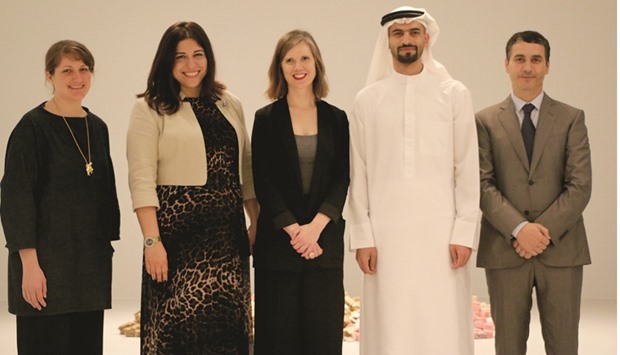
COLLECTIVE EFFORT: Abdellah Karroum, Director of Mathaf, right, and, Laura Barlow, Mathaf Curator, third from right, with other guests at the opening of the exhibition. Photos by Umer Nangiana