


Tens of thousands of refugees and migrants were stuck in camps and ports across Greece yesterday as authorities struggled to convince them that the main passage to reach wealthy northern Europe has shut.
By early morning hundreds more people, many from the Middle East and Africa, had reached Greek islands, days after the shutdowns along the “Balkan route” were imposed.
Their arrival helped swell the number of those stuck across the country to more than 42,000.
At a sprawling, muddy tent city near the northern border town of Idomeni, 12,000 people, among them thousands of children and babies, waited to cross to Macedonia.
“These people maintain the hope that a number of them will cross to the north,” Citizen Protection Minister Nikos Toskas told Greek TV. “We’re trying to convince them ... that the Balkan route has closed.”
Further south, more than 3,500 people waited at the main port of Piraeus near Athens after having arrived on ships from the eastern Aegean islands.
“At Piraeus we spent five hours trying to get people on buses and take them to a camp, but they didn’t want to board,” Toskas said. “They think that once you reach Idomeni, you cross to central Europe.”
Scuffles have broken out at Idomeni this week as migrants and refugees scrambled for food and firewood.
Tensions flared briefly yesterday and at least one man was injured, with blood streaming down his face, during a handout of supplies.
Many have slept in the open, often in the rain and low temperatures.
“In Syria we are fighting ISIS (Islamic State militants), now we are fighting nature and I think it’s worse,” said Ali, a Syrian from Aleppo who has been in Greece for 20 days.
“ISIS has a limit but nature (has) no limit,” he told Reuters.
Greece has been the main entry point into Europe for more than a million refugees and migrants since last year.
More than 130,000 people have arrived this year alone, stretching the country’s limited resources.
So far, Greece has the capacity to host 30,000 people at camps and centres across the country and aims to raise that to 50,000 by next week, Deputy Defence Minister Dimitris Vitsas said.
“We need to convince these people, in every possible, non-violent way, that there are shelters in mainland Greece to host them,” he told Greek radio.
The EU launched a new aid programme last week worth an initial €700mn.
Greece, its economy blighted by the eurozone debt crisis, was expected to be the main beneficiary of the scheme.
During a visit to Athens yesterday, the EU’s commissioner for humanitarian aid, Christos Stylianides, reiterated the EU’s support and said the bloc stood ready to help Greece with further funds.
“We have a moral duty as Europeans to offer this help to refugees,” Stylianides told reporters after meeting Prime Minister Alexis Tsipras, adding other European funds were available besides humanitarian help.
Macedonia, which erected a razor wire fence at its border with Greece, criticised Greece yesterday for doing too little despite the support it has received.
“The get all they want. The only problem is they’re doing nothing with it,” Macedonian President Gjorge Ivanov was quoted as telling German daily Bild.
Pressed for papers, Egyptian migrant jumps from German train to his death
An Egyptian teenager, discovered hiding beneath a bench on a German night train, jumped out of a window and died after officials asked to see his papers, German police said yesterday.
The 17-year-old handed the officials migration documents, issued in Austria and identifying him as an Egyptian national, during checks on a night train early yesterday near the German-Austrian border.
While police were looking at his papers, the young man escaped into another compartment, opened the window and jumped out of the moving train, two young American women who witnessed the incident told the police.
Police closed the tracks and discovered the body.
Federal police had registered the man on the German-Austrian border a few weeks ago and sent him back to Austria, a Munich police spokesman said.
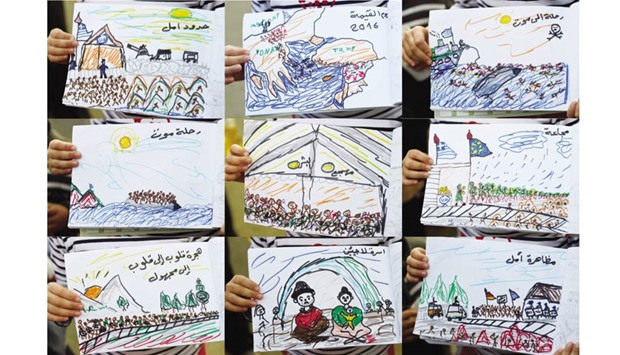
A combination of pictures taken yesterday shows drawings by eight-year-old Schecherezade from Aleppo, Syria, displaying her experiences during the exodus from her country to a makeshift camp at the Greek-Macedonian border, near the Greek village of Idomeni, where thousands of refugees and migrants are stranded by the Balkan border blockade.