


Agencies/Dubai
The US and Gulf Arab states are not bound by a Yemeni parliament decision to grant President Ali Abdullah Saleh immunity from prosecution over civilian deaths during protests against his rule, Human Rights Watch said yesterday.

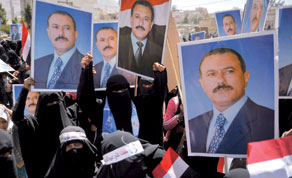
Supporters of outgoing Yemeni President Ali Abdullah Saleh hold up his posters during a rally outside the US embassy in Sanaa yesterday condemning a shoe-throwing protest targeting Saleh in New York
HRW said all countries should impose an asset freeze and travel ban on Saleh, now having medical treatment in the US, and other Yemeni officials implicated in serious rights violations committed since unrest began early last year.
“The US, EU and Gulf states should make loud and clear that the immunity is no good abroad and should be revoked at home,” said Letta Tayler, HRW’s Yemen researcher, in a report on human rights abuses in the flashpoint city of Taez.
The New York-based rights group said security forces killed at least 120 people in Taez last year while suppressing mass demonstrations against Saleh’s 33-year rule.
“Saleh is entitled to medical treatment, but he and his aides have no right to immunity from prosecution for international crimes,” Tayler said. “No one responsible for grave international crimes should get a free pass.”
As head of state, Saleh enjoys diplomatic immunity abroad until he formally leaves office following a February 21 presidential election to choose his successor.
Saleh flew to the US for medical care last month, but said on Tuesday he would return to Yemen before the vote, casting doubt on his commitment to let go of power in line with the transition plan forged by Yemen’s Gulf neighbours.
That plan, which sets Vice President Abd-Rabbu Mansour Hadi up as the sole candidate, has angered many Yemenis who feel cheated by a lack of choice at the ballet box.
Hadi pledged in a speech on Tuesday to lead Yemen’s political transition using “dialogue and logic, not weapons”.
HRW said the new government should authorise investigations into violations of humanitarian law by Saleh and others.
“President Saleh’s forces killed and wounded hundreds of civilians, evicted hospital patients and blocked war wounded from reaching care,” Tayler said.
The report says security forces shot peaceful demonstrators in Taez, bulldozed the sites of sit-ins, set fire to protesters’ tents and shelled populated areas of the city, the last of which is a direct violation of international laws governing war.
Meanwhile, dozens of women protested outside the US embassy in Sanaa against what they said was an attack on Saleh in New York.
“We demand that the US apologise to Saleh as he has immunity and US authorities must protect him,” said Najat al-Wajra, a protest organiser.
A video posted on Youtube this week showed Saleh outside what looks like his hotel in New York surrounded by bodyguards blowing kisses amid loud chants, by what appears to be protesters gathered on the other side of the street, demanding his trial.
“Saleh hold your head up high, the Yemeni people are your guards,” chanted the women as they waved Saleh’s pictures and Yemeni flags.
“We are the president’s supporters. (Yemen is) not Egypt or Tunisia,” they shouted, referring to the two Arab countries where uprisings forced their autocratic leaders out of office.
lAt least 10 tribesmen were killed in northern Yemen during clashes with Shia rebels, the defence ministry said yesterday.
The uprising against Saleh has severely weakened central government control over swathes of Yemen, allowing the rebels, known as Houthis, to seize the governorate of Saada, which borders Saudi Arabia.
The latest clashes took place in Hajja province, which neighbours Saada, after tribesmen accused the Houthis of trying to grab more territory.
“Security reports say there was fierce fighting between the two sides ... The clashes between the Houthis and the tribesmen took place in and around a technical college and other areas,” said a statement on the defence ministry’s website.
The number of Houthis killed was not known.
Saudi Arabia briefly fought the Houthis in Saada after they seized Saudi territory in 2009.
Saudi Arabia and the US fear protracted political upheaval in Yemen is giving Al Qaeda’s regional wing room to gain a foothold near oil shipping routes through the Red Sea.