


The moving tale of a Buddhist monk who devoted his life to tending to homeless children and the emotional journey of one such adorable child Tashi, unfolds on the big screen in Doha today.
A special, free screening of the much-acclaimed documentary Tashi and the Monk by filmmakers Johnny Burke and Andrew Hinton will be held at Grand Hyatt Doha’s Al Silia Ballroom at 7pm today.
Around eight years ago, monk Lobsang Phuntsok, who was hand-picked by the Dalai Lama to share Tibetan Buddhism with the West, gave up as a spiritual teacher in the US and returned to the region of his birth to rescue homeless children.
Ever since, Phuntsok has built a unique community in the foothills of the Himalayas called Jhamtse Gatsal (Tibetan for ‘The Garden of Love and Compassion’), which makes for a permanent home for 85 orphaned or abandoned children, all of who learn to live compassionately.
As Phuntsok overcomes numerous challenges to keep the initiative running on a remote mountaintop surrounded by poverty, the film weaves in the story of Tashi Drolma, Jhamtse’s newest arrival who recently lost her mother and was abandoned by her alcoholic father.
Tashi struggles initially to find her place amongst 84 new siblings. Gradually, as Phuntsok and the community work their magic, we witness her transformation from alienation and tantrums into someone capable of making her first real friend. The atmosphere of warmth and support at Jhamtse Gatsal provides a backdrop to the unfolding stories.
On the eve of its screening here, Community caught up with Burke for a chat:
Q. How did you first learn about this story and what about it made you and Andrew swing into action and make a film on it?
Andrew was in India doing a project when he got a phone call from an American film production company. They wanted him to go to the remotest and poorest part of India, Arunachal Pradesh, to film an American high school student who was helping out at the Jhamtse Gatsal children’s community. Once Andrew was there, he got talking to Lobsang, ‘the monk’, and realised he had an amazing life story.
Andrew returned to England to tell me about the place, and we decided to make a film about the community. We were particularly inspired by the amazing atmosphere at the community, and the success they were having using simple love and compassion to help cure kids who had undergone severe trauma at a young age.
Q. Phuntsok faces several difficulties to run Jhamtse Gatsal. What did you find to be his biggest challenge?
Tashi was clearly the biggest day-to-day challenge that Lobsang and all the other staff were facing. With her tantrums and spitting and biting, she was a real handful. But the truly biggest challenge Lobsang faced was dealing with having to say no to so many kids who wanted to enter the community.
With 84 children, they were already sleeping two to a bed and couldn’t accept any more. He had said no to more than 1,000 kids already when we were there, and it weighed very heavily on him, knowing that saying no could mean the difference between life and death for that child.
Q. The place seems to resonate with warmth and kindness. What sense did you get from the atmosphere at Jhamtse Gatsal and how did you manage to capture it in your film?
The atmosphere at the community is truly amazing; the kids and the staff are all very open-hearted. Not having much in the way of material possessions, they appreciate the smallest things. Andrew and I both felt incredibly privileged to spend time there, and both felt our own spirits lifted by the infectious energy of the kids.
The key to capturing it on film is time and patience. We were there for nearly three months filming, and in that time the kids gradually got so used to us that they completely ignored us, and it’s at that moment that you are able to see and capture what is really happening.
Q. You seem to have both witnessed and filmed Tashi’s transformation. What are your impressions of Tashi?
One of the teachers said of Tashi that she is “a big personality in a small body” and that “when she is older, she would either be the President of India, or the leader of a rebel gang of bandits living in the mountains, and it was impossible to say which direction she would go, but either way, she would be impactful on her surroundings”.
To us, Tashi was an incredible gift, a bundle of activity who every time we filmed her would give us amazing scenes for the film: sometimes very naughty (fighting in the classroom), other times very funny and playful, and then some other times haunting and tragic. Filming Tashi was wonderful as she was always up to some mischief.
Q. What about this film makes it an important watch?
The film has now won 17 awards, including two prizes at the IDA, the International Documentary Association, which is the documentary equivalent of the Oscars. Audience feedback tells us that they are responding both to the powerful subject matter but also to the way we have made the film.
We were determined to keep the film-making style simple and sensitive. Rather than have a narrator leading you through the film, we allowed the film to speak for itself, and let the audience experience their own personal journey. The film seems to trigger people’s memories of their own childhood, both good and bad.
Q. Are there lessons on life to be gleaned from it?
We feel the film is important to watch as it carries a message to a worldwide audience that the spirit in which you live is more important than the material possessions you have. Lobsang has turned the pain of his own troubled childhood (abandoned by his mother in an outside toilet, and left to die), into a positive ambition, which is to make sure that no child experiences what he had to go through. He is a true inspiration to both Andrew and myself, and anyone who watches the film.
Also in an age where many troubled children are treated medically with drugs such as anti-depressants, we see Jhamtse Gatsal offering another way: that a simple formula of love and kindness can, in fact, heal even the deepest wounds.
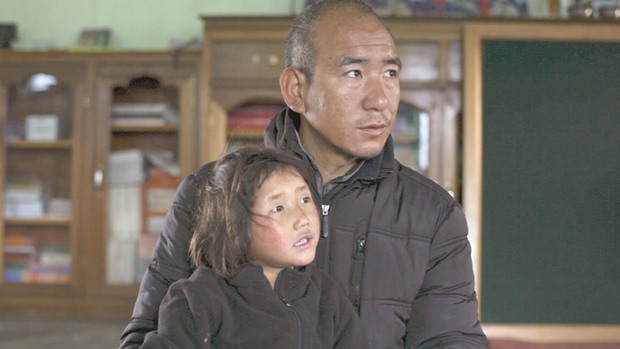
BOND: Tashi and the monk.