


 |
|
|
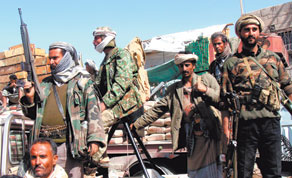
Hundreds of Al Qaeda gunmen bowed to tribal pressure yesterday and withdrew from a Yemeni town they had held for nine days after authorities pledged to free 15 militants, tribal sources said.
“They have left the town” of Radda 130km southeast of Sanaa, one tribal source said hours after a senior military official said mediators had convinced the extremists to withdraw.
Some tribal mediators, who have formed a committee of 35 dignitaries from seven different Yemeni cities, said they had warned the militants to leave Radda voluntarily or be forced out.
Usually heavily armed tribes still play a vital role in Yemeni politics and society, joining the army to battle Al Qaeda-linked militants who have taken over several regions across the south and east.
Radda was overrun on January 16, the latest in a series of towns and cities to fall as Al Qaeda takes advantage of a central government weakened by months of protests.
“Tribal mediation carried out by Sheikh Hashed Fadhl al-Qawsi succeeded, after three days of talks, to convince the armed Al Qaeda men to leave Radda,” a military official said late on Tuesday.
A local dignitary, Ahmed Kalaz, confirmed the departure of Islamist fighters he described as close to Tarek al-Dahab, brother-in-law of the Yemeni-American extremist Anwar al-Awlaki, who was killed in a US air strike last September.
“They’ve retreated to Al Manasa,” Dahab’s native village some 30km to the southeast, Kalaz said.
In exchange, the mediators promised the gunmen that 15 of their fellow militants would be freed and a committee comprising town residents would be formed to replace corrupt officials.
The commission was formed and so far five militants had been released, with the rest to follow in the next two days.
Khaled al-Dahab, Tarek’s brother, said their third brother Nabil, a jihadist seized by Syrian authorities as he was returning from Iraq and handed over to Yemen, was among the five freed yesterday.
“Five Al Qaeda detainees, among them Nabil, have been released,” Khaled told AFP by telephone.
In a statement on an Islamist website, the “Partisans of Shariah” militants said that they had agreed to leave in return for these demands being met.
They said they had entered “Radda to reform the situation there by implementing God’s law and removing corruption and the corrupt” officials.
As news of the withdrawal spread, residents took to Radda’s streets in celebration, firing shots in the air.
“Our town is celebrating this event as war and chaos have been avoided,” said one, Faisal al-Riashi, reached by telephone.
“Life in Rada is returning to normal and residents have begun removing rocks” used to block roads, said another resident, Aref al-Amri. He added that shops were reopening.
Residents also paraded through Radda carrying banners reading “The farce is over.”
Opponents of President Ali Abdullah Saleh, who left Yemen on Sunday for the US via Oman for medical treatment, accuse him of deliberately handing over towns and cities to Islamists in an attempt to gain Western support for his regime.
The strong jihadist presence in Yemen made Saleh a key ally in Washington’s “war on terror” before the Arab Spring uprisings sparked a wave of protests against his regime that he countered with deadly violence.
“Affash it’s no use, the people of Radda are united,” some banners carried during yesterday’s demonstration in Radda read, referring to the veteran leader.
Affash is Saleh’s original family name which he usually hides because it means “thug” in the local dialect. Al Qaeda members occupied several public buildings after taking Radda.
“If any of the conditions (to leave the town) are not met, the Partisans of Shariah will have the right to take the action that deters the traitors based on God’s law,” they said in the statement.
Meanwhile, 10 soldiers were wounded in clashes late Tuesday between Al Qaeda members and the army in the southern city of Zinjibar, where the militants have been battling the military since May, a government official said yesterday.
Hundreds have been killed from both sides as most of Zinjibar’s residents have fled to nearby cities.