


Reuters/Sanaa
Yemen’s parliament approved a law yesterday granting outgoing President Ali Abdullah Saleh immunity from prosecution, part of a deal for him to step down after nearly a year of unrest.

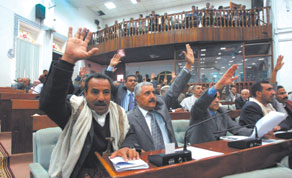
Members of Yemen’s parliament raise their hands to vote in favour of a law giving President Ali Abdullah Saleh immunity from prosecution in return for stepping down under a Gulf-brokered transition deal in Sanaa yesterday
Protesters and the opposition have accused the security forces, controlled by the president and aides, of using troops and snipers to kill hundreds of demonstrators who, inspired by revolts elsewhere in the Arab world, began protesting against his rule last January.
Lawmakers also backed Vice President Abd-Rabbu Mansour Hadi as the candidate for all parliamentary parties in a presidential election next month to replace Saleh, in power for 33 years.
The immunity law, backed by a majority, stops short of giving full protection to Saleh’s aides after being amended to say they would have immunity only for “politically motivated” crimes committed carrying out official duties, not for those considered “terrorist acts”.
A UN envoy welcomed the amendment limiting the immunity, which UN human rights chief Navi Pillay has said could violate international law.
“I am pleased that immunity law has been modified but it does not go far enough. The scope of the law is still too broad. The UN cannot condone a broad amnesty that covers UN classified crimes against humanity, genocide, war crimes, gross violations of human rights, and sexual violence,” Jamal Benomar said.
“We would have been more satisfied if these recognised categories of crimes were incorporated into the draft law.”
Human Rights Watch was far more critical. “This law sends the disgraceful message that there is no consequence for killing those who express dissent,” said HRW regional director Sarah Leah Whitson. “The Yemeni government should be investigating senior officials linked to serious crimes, not letting them get away with murder.”
The deal, part of the plan hammered out by Yemen’s Gulf neighbours to ease Saleh from power, will cover Saleh’s entire presidency and cannot be cancelled or appealed.
A Middle Eastern diplomat involved in the discussions over Saleh’s fate said on Friday the president still planned to visit the US for medical treatment but would not leave Yemen permanently.
Al Arabiya television said yesterday that Saleh planned to visit Oman and Ethiopia before going to the US for a medical check-up.
A senior Yemeni official said Saleh would have diplomatic immunity if and when he travelled to the US.
“We are waiting for a third country to approve the president’s short visit prior to travelling to the US,” said the official, who is not authorised to speak to the press and so declined to be named. The official suggested that the third country was an Arab nation.
Some activists said the immunity deal showed that the successes of the protests could easily be overturned.
“We have lost all faith in the political opposition. If they can grant Saleh this kind of pardon perhaps they will pass more laws against us in the future, maybe next time they will pass laws banning demonstrations. We, as the youth, can no longer trust them,” said protest leader Faizah Suleiman.
But activist Abdulaziz Sakkaf, 22, said: “It is of course controversial but it is necessary if a peaceful transfer of power has any chance of succeeding. I don’t support it in principle, but for pragmatic reasons.”
Yemeni Nobel Peace Prize winner Tawakul Karman said Saleh and his inner circle must be barred from returning to power if the country was to have any chance of restoring stability.
Analysts say impoverished Yemen may become a failed state as it also faces Shia rebels in the north, resurgent southern separatist sentiment and Al Qaeda-linked militants who have seized several towns in the south.
Saleh’s opponents accuse him of ceding territory to Islamists to bolster his assertion that his rule alone keeps Al Qaeda from growing stronger in Yemen, and ultimately aiming to retain power by sabotaging the transition deal.
Qaeda man among four killed in clashes: tribal official
Four people including an Al Qaeda militant were killed yesterday in clashes in the central Yemeni town of Radda, which a large force of extremists seized less than a week ago, a tribal dignitary said. Witnesses said a firefight erupted when dozens of Al Qaeda fighters used machineguns and shells to attack a house in the town centre, sparking return fire from residents. “Four people, including an Al Qaeda man, were killed,” the tribal official told AFP. The clash came following the failure on Friday of a third round of tribal mediation since the town was seized overnight on January 22. The same official said mediators had been unable to negotiate a retreat from the town of the insurgents because their leader, Tareq al-Dahab, refused to change his demands, the main one being that Radda become an “Islamic emirate”. On Friday, an Al Qaeda fighter was also killed by Radda residents who had formed vigilante committees to defend their areas. The militants met little resistance from security forces when they moved into Radda last Sunday night. Several sources in the town said more than 1,000 Al Qaeda gunmen invaded Radda, which is within striking distance of a strategic highway connecting Sanaa with the south and southwest.