


 |
|
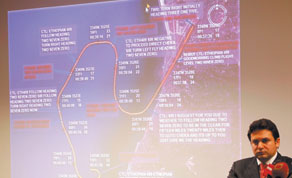
Omar Kadouha, head of Civil Aviation Safety, displays an investigation report on the Ethiopian Airlines flight that crashed after taking off from Beirut airport in 2010, during a news conference in Beirut yesterday |
Pilot error and inexperience were behind the 2010 crash of an Ethiopian airliner in Lebanon in which all 90 people on board died, according to a report released yesterday by Lebanese authorities.
Ethiopian Airlines immediately rejected the Lebanese findings saying the crash was likely caused by sabotage or a lightning strike.
“What is clear is that there were errors on the part of the pilot and co-pilot who are entirely responsible for the plane crash,” Transport Minister Ghazi Aridi told AFP, referring to the January 25, 2010 incident.
According to the 191-page report, the pilot had been overworked when the Ethiopian Airlines Boeing 737-800 crashed into the Mediterranean minutes after taking off from Beirut, killing 82 passengers and eight crew.
The majority of the victims were Lebanese.
The report said the pilot had flown 188 hours in 51 days on this type of aircraft “with the absolute minimum rest”.
Coupled with the captain’s relative inexperience with the jet was the fact that he was not familiar with the co-pilot and it was his first flight to Beirut, the report added.
The crew had also complained of having eaten a heavy meal which may have affected their sleep prior to the flight, it said.
“The investigation revealed that the probable causes of the accident were the flight crew’s mismanagement of the aircraft’s speed, altitude, headings and attitude through inconsistent flight control inputs resulting in a loss of control,” according to the report.
It said air traffic control kept advising the pilot to steer the plane in one direction that stormy night but he failed to follow instructions.
The report also states that the flight data recorder indicates the captain had asked the co-pilot to engage the auto-pilot but his instruction was not carried out.
Aridi said the plane was sound and a transcript of the exchange that took place between the crew and the tower control on takeoff showed there was no problem with the aircraft or instruments on board.
He said the Lebanese report on the crash was in line with findings by French and American investigators.
But the airline’s management rejected the Lebanese report.
“The aircraft disintegrated in the air due to explosion, which could have been caused by a shoot-down, sabotage or lightning strike,” Desta Zeru, vice president of flight operations for Ethiopian Airlines, said in a statement.