


 |
|
|
Several attacks and a police compound siege in west Iraq by suicide bombers dressed as police killed seven officers yesterday, raising doubts about security forces’ abilities after US troops left.
The co-ordinated blasts and shootings, apparently aimed at freeing detainees held for involvement in a sectarian massacre in September, come with the country mired in a festering political row, and deal a blow to US and Iraqi officials’ assertion that local forces are able to maintain internal security.
Yesterday’s violence in mostly Sunni Ramadi came a day after a suicide attacker targeting Shias killed 53 people on the outskirts of the southern city of Basra, the latest in a series of attacks that have killed nearly 200 in less than a month.
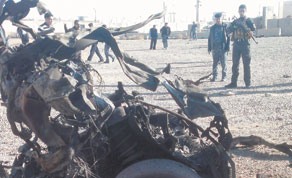
In Ramadi, two initial car bombs exploded at around 11.30am near Dawlah Kabir Mosque in the centre of the city, before a third car bomb went off in the same area.
A short time later, a fourth bomb in a car driven by a suicide attacker detonated near a police compound in Ramadi, followed quickly thereafter by two suicide bombers blowing themselves up at the gate, according to Anbar security command chief, Lieutenant General Abdulaziz Mohamed Jassim.
Six gunmen, all disguised in police uniforms and wearing explosives belts, then stormed the compound, which houses the provincial anti-terror department, Ramadi’s police department and other offices, before holing up in a building that was still under construction.
“The attackers controlled the roof of the building, and clashes started between police and the attackers,” Jassim said at a news conference.
“After two hours, the police forces entered the building and all the suicide bombers detonated themselves.”
Jassim said the compound houses a detention facility that was holding people accused of involvement in the September 2011 killing of 22 Shia pilgrims in Anbar, and added that it appeared the attackers were aiming to free them.
The assault on the police compound left seven policemen dead and 16 wounded, while the initial three car bombs in central Ramadi wounded three civilians, according to a medic at Ramadi General Hospital.
Separate bombings in the refinery town of Baiji, the oil-rich city of Kirkuk, and the disputed town of Saadiyah, all north of Baghdad, left one person dead and 13 people wounded, including three police.
The attack in Ramadi was reminiscent of a siege three months ago at a police station in the nearby town of Al Baghdadi, also in Anbar province.
At the time, the local police chief and four others were killed when gunmen disguised in police uniforms set off explosions, clearing the way for them to overrun the building.
Anbar was a key Sunni insurgent base in the years after the US-led invasion of 2003, but after 2006 local tribes sided with the American military against Al Qaeda and day-to-day violence has dropped dramatically.
However the province, and particularly its capital Ramadi, has been the target of frequent attacks in previous years.
In June 2011, at least three explosions near provincial government offices in Ramadi killed 10 people and wounded 15 others.
And in January of last year, a suicide bomber blew up an explosives-packed car carrying Anbar governor Qassim Mohamed Abid, but he was unhurt.