


 |
|
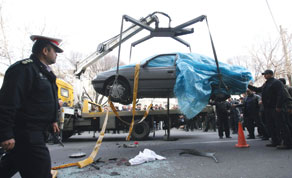
Policemen and onlookers stand around the site of the blast that killed nuclear scientist Mostafa Ahmadi-Roshan in Tehran yesterday |
An Iranian nuclear scientist was blown up in his car by a motorbike hitman yesterday, prompting Tehran to blame Israeli and US agents but insist the killing would not derail a nuclear programme that has raised fears of war and threatened world oil supplies.
The fifth daylight attack on technical experts in two years, the killer’s magnetic bomb delivered a targeted blast to the door of 32-year-old Mostafa Ahmadi-Roshan’s silver sedan as he drove down a busy street close to Tehran University during the morning rush hour. The chemical engineer’s passenger also died, Iranian media said, while a passerby was slightly hurt.
Israel, whose military chief had warned Iran only yesterday to expect more mysterious mishaps, declined to comment. While many analysts saw Israeli or Western involvement as eminently plausible, the role of local or other Middle Eastern hands in a deadly shadow war of bluff and sabotage could not be ruled out.
The killing, which left debris hanging in trees and body parts on the road, came in a week of heightened tension:
Iran has started an underground uranium enrichment plant and sentenced an American to death for spying; Washington and Europe have stepped up efforts to cripple Iran’s oil exports for its refusal to halt work that the West says betrays an ambition to build nuclear weapons, not the power plants Iran claims.
Iran has threatened to choke the West’s supply of Gulf oil, drawing a US warning that its navy was ready to open fire to prevent any blockade of the strategic Strait of Hormuz.
However, analysts saw the latest assassination, which would have taken some preparation, as part of a longer-running, cover effort to thwart Iran’s nuclear development programme that has also included suspected computer viruses and mystery explosions.
While fears of war have forced up oil prices, the region has seen periods of sabre-rattling and limited bloodshed before without reaching all-out conflict. However, a willingness in Israel, which sees an imminent Iranian atom bomb as a threat to its existence, to attack Iranian nuclear sites, with or without US backing, has heightened the sense that a crisis is coming.
Iran’s Atomic Energy Organisation, which has failed to persuade the West that its quest for nuclear power has no hidden military goal, said the killing of Ahmadi-Roshan would not deter it: “We will continue our path without any doubt ... Our path is irreversible,” it said in a statement carried on television.
“The heinous acts of America and the criminal Zionist regime will not disrupt our glorious path ... The more you kill us, the more our nation will awake.”
First Vice President Mohamed Reza Rahimi, quoted by Irna news agency, said: “Iran’s enemies should know they cannot prevent Iran’s progress by carrying out such terrorist acts.”
Preparing for the first national election since a disputed presidential vote in 2009 brought street protests against 30 years of clerical rule, Iran’s leaders are struggling to contain internal tensions. Defiance of Israel and Western powers plays well with many voters in the nation of 76mn.
Israel, whose Mossad intelligence agency has a history of covert killings abroad, declined comment on yesterday’s bombing.
On Tuesday, armed forces chief Lieutenant General Benny Gantz was quoted as telling members of parliament: “For Iran, 2012 is a critical year in combining the continuation of its nuclearisation, internal changes in the Iranian leadership, continuing and growing pressure from the international community and things which take place in an unnatural manner.”
There was no immediate reaction to the early morning attack from the US. Its ally Britain, whose Tehran embassy was ransacked in November, called suggestions of London’s involvement “baseless” and condemned the killing of civilians.
The attack nonetheless, bore some of the hallmarks of the work of sophisticated intelligence agencies capable of circumventing Iran’s own extensive security apparatus and also showing some apparent care to limit the harm to passersby.
While witnesses spoke of a frighteningly loud explosion at 8.20am and parts of the Peugeot 405 sedan ended up in the branches of the trees lining Gol Nabi Street, much of the car was left intact. The containment of the blast to the vehicle suggested a charge designed both to be sure of killing the occupants but also to limit serious injury to those targeted.
Witnesses said a motorcycle, from which the rear pillion passenger reached out to stick the device to the side of the car, made off into the heavy commuter traffic.
Though the scientist killed - the fourth in five such attacks since January 2010 - was only 32, Iranian media described him as having a senior role at the uranium enrichment plant at Natanz, near Tehran. The semi-official news agency Mehr said Ahmadi-Roshan had recently met officials of the UN nuclear watchdog, the International Atomic Energy Agency.
IAEA officials could not confirm that, however.
Iranian foreign ministry spokesman Ramin Mehmanparast was quoted by Isna news agency as calling on the IAEA and other world bodies to condemn the latest killing.