


 |
|
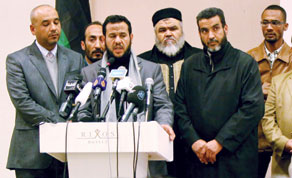
Abdelhakim Belhaj, chairman of the Tripoli military council, speaks during a press conference in Tripoli following deadly clashes in the capital yesterday |
A gunfight erupted in central Tripoli yesterday, killing four, as a group of former rebels from Libya’s third biggest city Misrata clashed with some ex-fighters from the capital, witnesses said.
The two groups of former rebels, who helped topple Muammar Gaddafi’s regime, traded anti-aircraft and heavy machinegun fire as they fought in broad daylight in a Tripoli neighbourhood.
The fighting raised fresh concerns over the issue of militias in Tripoli and the potential security threat they pose months after Gaddafi’s ouster.
The gunfight broke out between Al Zawiyah and Al Saidi streets near a building used as intelligence headquarters by the former regime.
AFP reporters saw the entire neighbourhood surrounded by hundreds of former rebels amid bursts of gunfire.
“Four thwars (revolutionaries) were killed in the incident and five or six were injured,” Abdelhakim Belhaj, the head of the Tripoli military council, told a press conference.
“I regret the incident. I don’t want to go into details but it was the result of a problem between Misrata thwars and members of the military council of Zawiyah street,” Belhaj said.
“What happened is an irresponsible act and the situation is now under control. Since afternoon we did not hear any gunshots,” he added.
Earlier yesterday, Massud al-Khadar, a member of the militia from the neighbourhood, told AFP that two of its fighters were killed in the clashes which began in the morning.
He said the violence started when a rival militia from Misrata attacked his group based near the former intelligence building.
Some witnesses said the Misrata fighters had arrived in the area to free one of their comrades detained by the neighbourhood militia.
The head of the security committee in the interior ministry, Colonel Mustafa Noah, told the official WAL news agency his ministry’s forces were surrounding the neighbourhood and “the situation was under control”.
He said “the clashes occurred between former thwars (revolutionaries) of Al Zawiya street and thwars from outside Tripoli”.
“An investigation has been launched to determine the circumstances and causes of the incident,” he added.
Another version of the clashes given by residents was that forces linked to the new government’s interior ministry may have tried to retake the intelligence building yesterday, provoking a clash with the militia group occupying it.
Those reports could not be independently verified, and the interior ministry declined to comment.
Ex-rebels, who remain organised in militia brigades, are visible in many parts of the capital, and some have taken control of former government buildings to use as bases.
Fathi Ali Bashagha, spokesman of the Misrata military council, played down the clashes.
“Such incidents are expected as there are so many arms in the city,” Bashagha said.
“It is the fault of the government. There is no authority and the government has lost more than one month of time. It has done nothing” in resolving the security issues, he added.
The presence of militia groups in Tripoli is one of the biggest challenges facing the new Libyan rulers.
The militias, several of them from outside Tripoli, helped liberate the capital from Gaddafi’s forces in August. Since then, they have stayed put in the city and refused to return to their hometowns.
In the absence of regular security forces, the militias provide a semblance of order on the streets.
Powerful militias from Misrata and towns such as Zintan, southwest of Tripoli, are even guarding key installations in the capital.
Tripoli residents, however, have been protesting against the presence of militias from outside the capital, saying it has actually raised security concerns.
Several militia commanders have said their fighters will leave Tripoli only when a new national army is formed. Libyan officials have said most of the former rebels will be integrated into the security forces.
lA former colonel in Gaddafi’s military has been appointed as the new chief of staff of the Libyan army, two members of the country’s ruling National Transitional Council told AFP yesterday.
Yussef al-Mangush, who took voluntary retirement from Gaddafi’s military and even participated in the rebellion against the former Libyan leader, was promoted to the rank of general and appointed as chief of staff, said NTC member Abdelrazzak al-Aradi.
His appointment was confirmed by Fathi Baaja, another member of the NTC from the eastern city of Benghazi, the cradle of the uprising that toppled Gaddafi.
The post has been vacant since the murder in July of General Abdel Fatah Yunis, who commanded the former rebels in eastern Libya against Gaddafi’s diehards.