


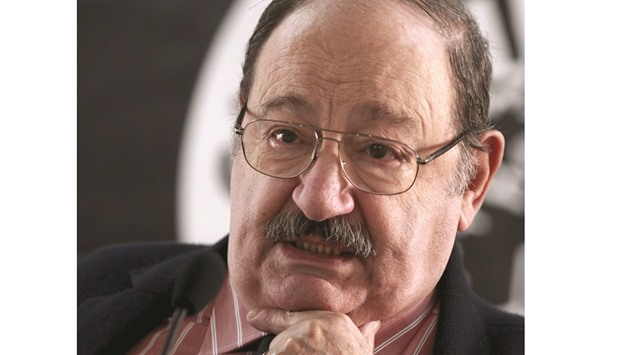
Umberto Eco: far from an ivory tower intellectual, he loved self-deprecation.
Umberto Eco, who died on Friday aged 84, was one of Europe’s leading intellectuals, known for his academic work, bestselling novels, journalistic efforts, political engagement and love of wordplay.
The La Repubblica newspaper, part of the left-wing media group which published his fortnightly columns in the l’Espresso magazine for more than three decades, saluted him on its website as “the man who knew everything”.
Eco shot to international fame relatively late in life, with the 1980 historical mystery The Name of the Rose. The story became a 1986 film starring Sean Connery as a 14th century Franciscan monk who battles superstition to solve a murder in a monastery.
“Please don’t ask why at a certain point, suddenly, I wrote my first novel, because I am fed up of being asked; each time I have given different answers (all of them obviously false,)” he told La Repubblica in 2002.
Eco’s later works included Foucault’s Pendulum in 1988 and The Island of the Day Before in 1994. Last year he published Numero Zero, a satire on modern Italy, and the posthumous Pape Satan Aleppe, a collection of his journalistic essays, is due out this year.
Born in Alessandria, a provincial city in north-west Italy, on January 5, 1932, Eco graduated in philosophy in 1954 with a thesis on influential medieval thinker Thomas Aquinas.
He went on to become a university professor in 1961 and retired from teaching in 2007.
Italian Prime Minister Matteo Renzi paid tribute to “an extraordinary example of a European intellectual, (who) combined a unique understanding of the past and an insatiable capacity to preempt the future”.
Eco was a leading expert in semiotics - the study of signs and symbols - and medieval studies, but also a lover of pop culture, cinema and comics, famous in his home country for writing an essay on TV quiz host Mike Bongiorno.
Far from an ivory tower intellectual, he loved self-deprecation.
“I am a failure,” he said in an interview.
“My real ambition would have been to become a nightclub pianist..... It really did not work out for me. Oh well.”
He worked for RAI state television and the Bompiani publishing house, was one of the founders of Gruppo ’63, an avantgarde literary movement of the 1960s, and later emerged as a vocal critic of media mogul-turned-premier Silvio Berlusconi.
One of his last public acts was contributing to last year’s foundation of a new publishing house, La Nave di Teseo, born out of opposition to the takeover of RCS Libri, publisher of Eco’s works, by the Berlusconi family-owned Mondadori group.
Eco was also a committed European, scarred by the experience of growing up during World War II.
He leaves behind a German-born wife, art academic Renate Ramge, and two children, Stefano and Carlotta.