


AFP/Tripoli
Hundreds of minority Amazigh Berbers yesterday warned of a steadfast campaign against the new government as they demanded an apology from Libya’s premier for excluding their community from his cabinet.

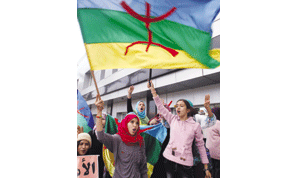
Libyan Berbers take part in a protest at the prime minister’s office in Tripoli yesterday, seeking better representation in the new governing bodies of the country
“The revolution has not ended. It continues,” shouted protesters as they pounded their fists and palms on the front wall and pillars of the prime minister’s office building in Tripoli.
They marched to Abdel Rahim al-Kib’s office from Tripoli’s landmark Martyrs Square where they had gathered early on Sunday.
The Berbers want to be represented in the new cabinet and their rights and language, Tamazight, to be officially recognised.
“Our people want an apology from the prime minister. We want to know why we are being isolated. Our people fear that there will be repetition of what happened under (Muammar) Gaddafi,” said prominent Amazigh activist Suleiman Dogha who had worked closely with Seif al-Islam, Gaddafi’s most prominent son.
“They feel the new government has deliberately excluded their community,” said Dogha, who was one of the first vocal opponents of the Gaddafi regime when the rebellion against the dictator erupted in February.
Some protesters vented their fury at Kib when he briefly came out of the building to meet them.
“He said ‘I love Amazighs.’ That is not what we want to hear. That is something given as we all are Libyans,” said Youbas Halab, an art student, who said some protesters even shouted abuse at Kib.
“We wanted him to speak with us on this specific subject. But he did not and he went inside the building within minutes.”
A delegation of Berbers was later called in to meet the premier, protesters said.
The Berbers, who make up about 10% of Libya’s 6mn people, are angry after their community was left unrepresented when a new cabinet was unveiled last week.
During Gaddafi’s 42 years of hardline rule, the Amazighs - whose name means “free men” - were banned from speaking in public and writing or printing anything in Tamazight.
The Berbers have been present in Libya since before the Arab conquest in the seventh century, and are remembered for their military resistance to the Italian occupation which ended 60 years ago.
A minority nationwide, the Amazighs form a majority in the northwestern Nafusa mountains, in Zuwarah region 120km west of Tripoli and in Ghadamis province on the frontier with Algeria.
The Berbers are also angry of being left out despite having after being active from the start of the revolt against Gaddafi when they worked with Arabs to topple the regime.
With the war over, they now want to contribute and take their place in Libya’s political and cultural life. They want their language to be officially recognised in the new Libya.
Earlier yesterday they demonstrated at Martyrs Square in the capital. Chanting “Take our minister,” more than 500 members of the community - men, women and children - waved their blue, green and yellow flag as they set out to march to Kib’s office.
They demanded that their rights be accepted, also yelling: “Tamazight is our language and it must be recognised!”
Lawyer Milod Ahmed, a member of the National Amazigh Congress, said that the local council of Zuwarah had “frozen its ties with the National Transitional Council over the past five days” in protest at the new government.
Interim premier Kib “had said that his cabinet would be made of technocrats (but) where are these technocrats?” asked Khaled Zikri, an adviser to the finance ministry who is himself an Amazigh. “If this is true, then we have several qualified technocrats,” he said.
After last Tuesday’s unveiling of the cabinet, the National Amazigh Congress called on all Libyans, and Berbers in particular, to end cooperation with the NTC and government.
Yesterday’s protest comes two days after a similar rally by dozens of Amazighs.