


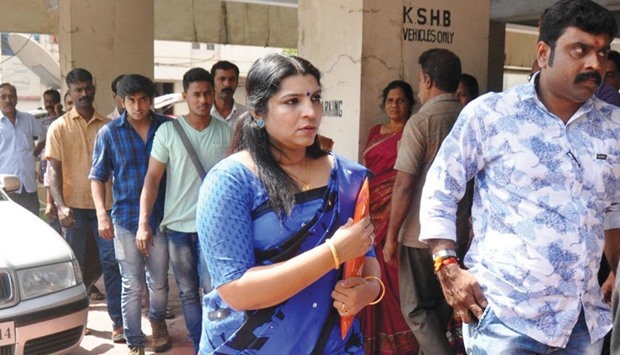
Solar scam accused Saritha Nair arrives to depose before a judicial commission probing the case in Kochi yesterday.
Saritha Nair, one of the key accused in the solar panel scam in Kerala, yesterday told an inquiry commission that she would not prefer in-camera proceedings but would hand over written statements on her trials and tribulations while she was involved in the business.
Deposing before the panel yesterday morning for the fifth day, Nair was told she had two options - either to give her statement during in-camera proceedings or in writing.
Nair said she preferred secrecy and chose the second option.
She said she would hand over two statements on her sufferings during the solar panel business.
“I will give two sealed covers to the commission, one would include all personal issues and the other would be related to business,” Nair told reporters after coming out of the commission’s office in the afternoon.
Her deposition concluded yesterday.
On Monday, she said she was “used physically and mentally” by many politicians. She also handed over three CDs containing phone conversations between Congress leaders and documents to prove her allegations.
Like in the past few days, yesterday too she blamed Chief Minister Oommen Chandy and said he was responsible for the rise and the fall of their solar panel business.
She also said Congress legislators Benny Behanan and P C Vishnunath took money from her for their political needs, but no receipt was given.
Solar scam accused Saritha Nair arrives to depose before a judicial commission probing the case in Kochi yesterday.
Modi should realise what goes around comes around
Delhi Diary/By A K B Krishnan/Gulf Times Correspondent
Perhaps at no time in the history of independent India has membership of the Rajya Sabha been of such significance to the ruling and opposition parties as at present.
As politics on both sides of the divide gives short shrift to ideologies and degenerates into a no-holds-barred personal combat, law-making becomes the prime casualty forcing a billion-plus people to look on helplessly.
Prime Minister Narendra Modi’s Bharatiya Janata Party is doing its best to get some very crucial laws like the goods and services tax (GST) and land acquisition amendment bills passed but the opposition led by the Congress Party, thanks to its superior strength in the upper house, is doing everything it can to block them. But before you start shedding tears for the BJP, be advised that the shoe was on the other foot just a couple of years ago and whatever the then ruling Congress was trying to do the BJP and its allies were hell-bent on thwarting.
So it’s all square for the politicians but hardly fair on the people. Those who know intricate economics are of the view that the GST alone can improve India’s GDP by as much as 2%, leave alone the ease of doing business it will bring in its wake. Currently Indian states are doing business with each other as if they are separate nations. The GST will make them a comprehensive whole. And it should have been implemented at least five years ago, if not more. The loss to the country can only be imagined.
But who cares? Not the BJP, not the Congress, not the Communists or the Samajwadis. But if you listen to the leaders of these parties holding forth on the benefits and importance of GST and such, you would feel there are no patriots like them.
Though its population of 1.25bn is second only to China’s, there are only six countries larger than India in terms of land mass and its population density of 392 per sq km gives it a respectable 33rd position in the world. Except for a few states like Uttar Pradesh, Bihar, Kerala, West Bengal and a couple of federally administered territories, the density is well below the national figure elsewhere. What this means is land itself is not exactly in short supply but its uneven distribution - overcrowded cities strung together by vast tracts of uncultivated or uncultivable land parcels - and unimaginative town planning has led to artificial shortage of land.
Although the Land Acquisition, Rehabilitation and Resettlement (Amendment) Bill 2015 still may not address many of the anomalies of land distribution, it was supposed to make it easier for the government to acquire land for vital public purposes even as it bestowed far better compensation to those whose land was being acquired. Many farmers say it is more profitable to surrender their land holdings than to engage in loss-making cultivation. Incessant reports of farmer suicides bear testimony to this. But like in the case of the GST, this bill too has been consigned to the back burner because the so-called socialists have thrown enough spanners in the works to keep the government under check in the Rajya Sabha.
Curiously, it is not as if Modi and his ministers did not know from day one that the upper house of parliament would be a stumbling block in their path to reforms. In the normal course, what do you do if you know you are going to face problems with someone but would nonetheless want to get things done by that very same person? You try to coax, cajole and sweet-talk your way through to achieve your target. Politics, as has often been said, is the art of the possible. In most cases end will justify the means. Confrontation and posturing, therefore, should be the last thing on your mind.
But see what Modi has done till date. To begin with he denied the leader of the opposition (LoP) status to the Congress despite the party asking for it. His excuse: the rule did not permit it although it was very much within his discretion. It was made out to be Speaker Sumitra Mahajan’s decision but that’s a cock-and-bull if ever there was one. Even someone like Arvind Kejriwal, who decimated all opposition in Delhi, had conceded that status to the BJP which has just three members in the assembly.
Not only had the BJP government stopped consulting the opposition in crucial matters, Modi personally went on a slanging-match against the ‘first family’ of the Congress. It was, to some extent, understandable in the hurly-burley of electioneering when Modi was campaigning in April-May 2014. But having won those elections and becoming the prime minister of the country he should have shown restraint. But he continued where he left off, thereby belittling the august office he holds.
Not many here believe that Subramanian Swamy is not getting any help whatsoever from the government in his fight against the Gandhis in the National Herald case. Of course Swamy is his own counsel and he may have a strong case too. But, like the Mahajan issue, this too has more than meets the eye.
To cap it all, Modi invoked Article 356 to impose President’s Rule and unseat a Congress government in Arunachal Pradesh even as the Supreme Court was seized of the matter. Constitutionally Modi may have been right. After all, the rule is no assembly should be kept pending for more than six months. Modi had acted on the state governor’s recommendation. But who is the governor and how was he appointed and what was the BJP’s role in stoking a rebellion in the state unit of the Congress are all questions that beg answers.
Where magnanimity of the victor was expected Modi showed a singular spitefulness usually associated with a bad loser. And then you want the opposition to help you pass bills! As you sow, so you reap, isn’t it? Pity that no one in his party has the courage to tell this to Modi.
Home buyers are in for some good times
Looks like it’s going to be payback time for India’s real estate developers. So those who are planning to invest in an apartment or house may better wait a while to make the most of it.
Ever since the economic upturn of the 1990s, the country’s real estate graph has witnessed a steady climb. Traditionally farming communities in and around cities like Delhi, Mumbai, Chennai, Bangalore, etc became overnight multi-millionaires as builders and developers came in droves to purchase large parcels of agricultural land and have them converted into residential and commercial complexes.
City suburbs like Gurgaon and Noida (for Delhi), Navi Mumbai and Thane (for Mumbai), Sriperumbadur and Avadi (for Chennai) and Whitefield and Yelehanka (for Bengaluru) saw exponential growth in construction. Even as several major developers pumped in vast sums of money to build high end villas, condominiums and commercial spaces, several fly-by-night operators hopped on to the bandwagon to make a quick buck and slink away. (One from Chandigarh made something like $7bn before being sent to jail! He is still cooling his heels.) As competition from small-time builders grew, some of the big guns also got greedier bringing the entire industry into disrepute. “Land Mafia” is an oft-heard expression whenever and wherever developers set up shop. But what goes up must come down too.
As demand rose, developers called the shots, forcing buyers to sign on one-sided agreements. In most cases, the fine print was never revealed. Developers would launch projects even before they buy the land or get government sanctions to build on it. The result: hundreds of projects across the country - some by well-known builders - have either been delayed or abandoned altogether because of cash crunch. That’s when the buyers look up the agreement clauses only to find them loaded in favour of the builder.
But things are looking up for buyers now. The Modi cabinet has cleared the Real Estate (Regulation and Development) Bill and what is more, it has the stamp of approval from the Rajya Sabha select committee as well. Apart from introducing a model builder-buyer agreement which is even-handed, the bill envisages strict penalties, including heavy fines and imprisonment, if the developer does not deliver. Promoters are also required to obtain all licences before selling any project and will also have to pay similar interest for delay as what they charge of the buyers in case of default. They will also have to deposit 70% of the project cost in an escrow account so as to end diversion of funds elsewhere.
Hopefully parliament will pass the bill during the upcoming budget session. Finally the consumer is in for some good times. Happy home buying!