


Denmark has decided to extend temporary controls along the country’s border with Germany for a further 20 days to stem the flow of migrants, a cabinet member said yesterday.
Inger Stojberg, minister for immigration and integration, said Danish police would continue to conduct spot checks at some of the country’s 15 border crossings to Germany until February 23.
Without the checks, Denmark risked “a large accumulation of migrants” from Germany, she told reporters after meeting with visiting Swedish Migration and Justice Minister Morgan Johansson.
The Danish measures were introduced on January 4, after similar moves by its neighbour Sweden.
Johansson thanked the Danish government for assisting in identity checks for passengers on buses, trains and ferries bound for Sweden under the rules introduced a month ago.
In a related move, Swedish national train operator SJ said it was resuming train services to Copenhagen that were suspended in January.
Train services between the capital cities of the two Nordic neighbours was to resume on March 1.
SJ operates up to six trains daily between Stockholm and Copenhagen, while up to five trains run from Copenhagen to the Swedish capital.
Denmark has said it feared illegal immigrants might remain in its territory after being denied entry to Sweden.
The German border controls are to try to prevent the numbers swelling even further.
Danish police said that about 33,500 people were subjected to spot checks between January 25 and 31.
This resulted in 66 people denied entry from Germany while 13 arrests were made over suspected people trafficking.
Several EU countries, including Germany and Austria, reintroduced border controls last year to cope with the growing number of migrants.
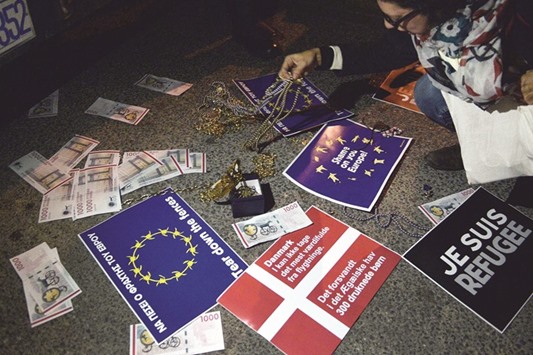
A woman leaves some jewellery in front of police officers standing guard in front of the Danish embassy in Athens during a protest yesterday against Denmark’s anti-migrant laws. The Danish parliament has passed a package of measures to deter refugees from seeking asylum, including confiscating valuables to pay for their stay, despite protests from international human rights organisations.