


 |
|
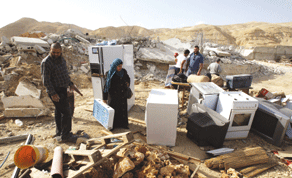
Palestinians check belongings after Israeli bulldozers razed four homes near the West Bank city of Jericho yesterday |
Ariel Rosenberg said the ministry had published formal notice of its intention to invite tenders to build 749 housing units in the southern Har Homa neighbourhood, and another 65 in Pisgat Zeev in the north.
He said the tendering process, which would be launched in “a month or two,” was linked to a government directive to speed up settlement construction after the Palestinians won membership of the UN cultural organisation Unesco.
“It will take a month or two before the tenders will be open to offers. I imagine that in another two or three months, the winners will be chosen and after that—another year, year and a half—building will start,” he said.
The decision to invite tenders “follows the recent government decision to speed up building in Jerusalem,” he said.
On November 1, Israel’s inner cabinet decided to speed up the construction of homes for Jews in Arab East Jerusalem and in other nearby settlements to punish the Palestinians for successfully joining Unesco a day earlier.
“We will build 2,000 housing units, including 1,650 homes in East Jerusalem and the rest in the settlements of Maaleh Adumim and Efrat,” a senior government official said at the time.
Israel also decided to freeze the transfer of customs duties levied on goods destined for Palestinian markets that transit through Israeli ports, which constitute a large percentage of the Palestinian budget.
“These measures were agreed ... as punishment after the vote at Unesco,” the official said.
Both Washington and Israel opposed the Unesco membership bid, describing it as a unilateral move which would jeopardise the chances of reviving peace negotiations.
But the decision to speed up settlement building in response drew a barrage of international condemnation led by the White House, which said it was “deeply disappointed” over Israel’s reaction.
Israel occupied the eastern sector of the Holy City during the 1967 Six-Day War and later annexed it in a move which was never recognised by the international community.
Since then, Israel has insisted that the whole of Jerusalem is its “eternal, indivisible capital” and does not consider construction in the east to be settlement building because the land falls within the city’s municipal boundaries, which were drawn up after the 1967 war.
The Palestinians want East Jerusalem as the capital of their promised state and oppose any Israeli attempt to extend its control over the sector.
l Bulldozers flanked by Israeli troops razed four Palestinian homes near the ancient city of Jericho yesterday, with Israel saying they endangered a nearby archaeological site.
Ammar Fakhuri, the owner of one of the buildings, said it was the third time that Israel had demolished properties he owned.
“They did it twice in the Old City of Jerusalem in 2004 and 2010 and now here,” he said, adding that yesterday’s demolition was carried out by two bulldozers with an army escort.
A spokesman for the department within the Israeli defence ministry, which administers the occupied West Bank, said the homes were built on government-owned land which was to be used by the nearby settlement of Vered Yericho.
The four structures were built “without permits on state-owned land designated for agriculture,” civil administration spokesman Guy Inbar said.
They were built “near an archaeological site with the risk of endangering it,” he added.
Inbar said the four structures were uninhabited and that the house owners, who came from East Jerusalem, had been warned to stop building, but had refused.
In August, a report by the UN agency for Palestinian refugees said that Israeli demolitions in the West Bank rose “alarmingly” in the first half of 2011, with 356 structures demolished in the first six months of this year, compared with 431 for the whole of 2010.
It said 700 people had been displaced by the demolitions in the first six months of 2011, compared with 594 in the whole of 2010.