


Qatar and the UAE are the most active Middle East countries using the renminbi (RMB) for direct payments with China and Hong Kong, according to a recent SWIFT data.
In Qatar, the RMB was used for 60% of all payments with China and Hong Kong, a huge rise of 247% compared to 2014, said SWIFT, a member-owned co-operative that provides the communications platform, products and services to connect more than 10,800 banking organisations, securities institutions and corporate customers in over 200 countries and territories.
In 2015, the UAE’s use of the RMB accounted for 74% of payments by value to China and Hong Kong, an increase of 52% against 2014.
However, looking at all cross-border flows worldwide, SWIFT data reveals that still the majority of the payments between these Gulf countries and China/Hong Kong are in the US dollar (USD) and subsequently intermediated, mainly by USD clearing banks.
“Use of the RMB has been rising across the Middle East region over the last few years. Adoption has been supported by developments such as the establishment of an RMB clearing centre in Qatar last year - the first in the Middle East – and the recent memorandum of co-operation signed between the People’s Bank of China and the Central Bank of the United Arab Emirates to set up RMB clearing arrangements in the UAE,” Sido Bestani, head of Middle East, Turkey and Africa at SWIFT, said. “We anticipate these and similar efforts will continue to drive RMB adoption across the region.”
In December 2015, the RMB remained stable in its position as the fifth most active currency for global payments by value and accounted for 2.31% of global payments, with an increased market share compared to 2.28% in November 2015. Overall, RMB payments value increased by 15.92% compared to November 2015, whilst in general all payments currencies increased by 14.43%.
“The old silk road trade routes between China and the Middle East are reawakening”, said Sunil Veetil, HSBC’s regional head of payments and cash management for Middle East and North Africa (Mena). “As trading relationships deepen and supply chains intertwine, more and more Middle East companies are beginning to weigh up the advantages of financing trade and investment flows in RMB,” he said.
The Qatar Renminbi Centre (QRC), the Mena region’s first RMB clearing centre, in December said it had cleared more than RMB131bn ($20bn) since June 2015, making it the third largest Industrial and Commercial Bank of China (ICBC)-managed clearing facility in the world by volume.
The RMB, the official currency of China, is an important key to international trade. The QRC has been improving ease of transactions between companies in Qatar and across the region and China through offering clearing and settlement services, increasing connectivity between markets that have strong economic and commercial ties.
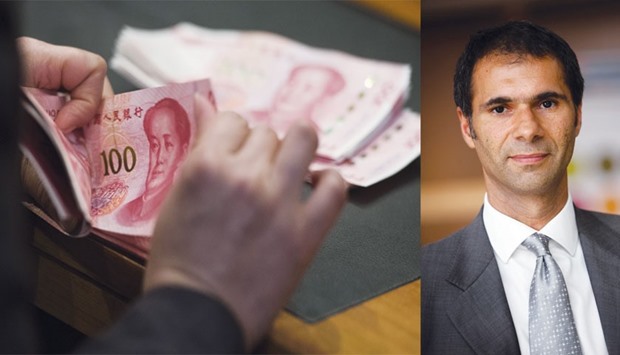
Bestani: Rising RMB adoption across the region. Right: An employee counts Chinese one-hundred yuan (renminbi) banknotes at the Bank of China Hong Kong headquarters in Hong Kong. In Qatar, the RMB was used for 60% of all payments with China and Hong Kong, a huge rise of 247% compared to 2014, said SWIFT.