


AFP/Makkah
More than 2mn Muslims gathered yesterday on Saudi Arabia’s Mount Arafat and its surrounding plain, marking the peak day of the Haj, the world’s largest annual pilgrimage.

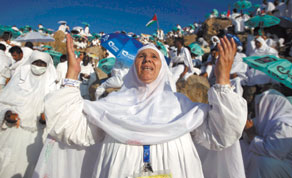
A pilgrim prays on Mount Arafat during the Haj yesterday
Dressed in white garments, the pilgrims filled the Namera Mosque in Arafat and the nearby streets and camps for collective prayer, led by Saudi Arabia’s top cleric, Sheikh Abdulaziz al-Sheikh.
“Islam is the solution for the problems” of Muslims, he said in a speech before the prayer began, warning the faithful of “a media and cultural invasion that seeks to weaken (their) faith”.
He urged Muslims to solve their problems “without interference from their enemies,” condemning those who want to “provoke hostility between you and your leaders.”
This year’s Haj coincides with the Arab Spring democracy protests that have swept many nations in the region and led to the ouster of the autocratic leaders of Tunisia, Egypt and Libya.
Saudi Arabia has been spared the unrest despite small-scale, sporadic Shia-led protests that took place in its Eastern Province, which the kingdom quickly controlled.
There were no reports of major incidents as security officials focused on crowd control.
“Things are going well and according to plans,” interior ministry spokesman General Mansur al-Turki told AFP.
Many went on buses, while others set off on foot from Mina, a tent-village that comes to life only during the five-day pilgrimage.
Others took the Mashair Railway, also known as the Makkah Metro, to go to Mount Arafat and its surrounding plains.
The Chinese-built railway is operating for the first time this year at its full capacity of 72,000 people per hour to ease congestion and prevent stampedes in which hundreds have been killed in past years.
The dual-track light railway connects the three holy sites of Mina, Muzdalifah and Mount Arafat—areas that see a massive influx of pilgrims during the Haj.
After sunset, pilgrims swarmed to Muzdalifah, half way between Mount Arafat and Mina, to spend the night.
Today, they return to Mina after dawn prayers for the first stage of the symbolic “stoning of the devil” and to make the ritual sacrifice of an animal, usually a lamb with the beginning of Eid al-Adha, or the Feast of Sacrifice.
On the remaining three days of the Haj, the pilgrims continue the ritual stoning before performing the circumambulation of the Kaaba shrine in Makkah and then heading home.
However, the gathering in the plains around Mount Arafat symbolises the climax of the Haj.
Mukhtar al-Rahman, who is more than 100 years of age, told AFP that “this is the dream of my life which took a century to come true”.
“The crowds have tired me and as you can see I can’t stand properly because of the huge crowds flooding” into the area, the elderly Bengali said panting as he looked for a small chair to sit on.
Meanwhile, Indonesian Noor Laila said: “I’m so happy to have set foot on Arafat’s sacred soil.”
“I want to wash away all my sins and ask God to forgive my mistakes. This is the first time I come to Haj and I hope it won’t be the last,” said the 36-year-old.
Malaysian Abdullah Wali al-Deen, 45, said he had been working for years for this day.
“I came here with my family after we managed to save enough money,” he said.
“Everyone in here is equal. There are no differences between various nationalities. This is the religion of peace, love and brotherhood.”
More than 1.83mn pilgrims have arrived in the kingdom from abroad, marking a 1.5% increase from last year, said Makkah governor Prince Khaled al-Faisal.
Several hundred thousand Saudis and foreign residents in the kingdom were also granted permits to join them, he added.
To help prevent chaos, the authorities have numbered buses and tents in Mina and Arafat according to the countries from which the pilgrims have come.
Saudi Arabia has invested billions of dollars over the years to avoid deadly stampedes that have marred the Haj in the past.
In January 2006, 364 pilgrims were killed in a stampede at the entrance to a bridge leading to the stoning site in Mina, outside Makkah, while 251 were trampled to death in 2004.
In July 1990, 1,426 pilgrims were trampled to death or suffocated in a stampede in a tunnel, also in Mina.
The deaths prompted authorities to dismantle the old bridge and replace it with a multi-level walkway with one-way lanes to ensure a smooth flow of pilgrims.
Saudi Arabia also launched a $10.6bn project for a new extension to Makkah’s Grand Mosque to increase its capacity to 2mn worshippers.
For the first time this year, the Haj is being streamed live on video-sharing website YouTube in co-operation with the Saudi government.
The stream can bee seen at youtube.com/Hajlive.