


Qatar’s office rents may soften in the next 12-18 months on additional supplies; even as rising population could stimulate demand for residential sector, especially at the lower end of the market, according to DTZ Qatar.
“With 300,000 sqm of new Grade A office accommodation becoming available within the next 12-18 months, there is a risk of downward pressure on rental prices in Doha,” DTZ Qatar said in a report.
Of the 300,000 sqm additional office accommodation likely to complete in West Bay within the next 12-18 months, which will increase supply levels; more than 200,000 sqm is at the QP (Qatar Petroleum) district, which may not be available to the market, it said.
In the longer term, once developments complete in Lusail, the large supply pipeline may result in downward pressure on rental levels as landlords compete for new tenants, it said. Finding that the majority of enquiries for office accommodation relates to requirements of less than 250 sqm and that demand from the private sector has also fallen in the past 12 months; it said to maintain current occupancy levels in 2016, there needs to be an increase in activity both from the public and private sectors.
Grade A offices in West Bay currently command up to QR280 per sqm per month for small suites of less than 500 sqm. Rents of QR160 per sqm per month are achievable for large lettings or lettings in buildings of lesser quality.
Elsewhere, office rents in secondary locations as Old Salata, Al Sadd, Airport Road, and C/D Ring Roads typically command between QR120 and QR180 per sqm per month, depending on the age and the standard of finish of the building.
Falling oil prices have resulted in a fall in demand for office accommodation as the government and hydrocarbon sector withdrew from the market in 2015, it said.
“In the final quarter of 2015, Qatar’s real estate market started to show signs that the drop in hydrocarbon prices is really beginning to bite. We think this is likely to continue into 2016 and the sector needs to be ready for a few tough months,” Mark Proudley, associate director, (Consultancy and Research), DTZ, said.
But the long-term trajectory for Qatar remains good with the government’s significant infrastructure investment at QR261bn providing fundamental support to the wider realty economy, he added.
On the residential market, DTZ Qatar said over the past decade, demand has been underpinned by strong growth in population, which recorded an 8% year-on-year increase to 2.42mn in December 2015.
“The result has been strong year on year rental increases since 2010 throughout the residential sector, as residential development has struggled to keep pace with the burgeoning population,” it said.
In December 2015, the Shura Advisory Council called on the relevant authorities to curb the increasing levels of rent, possibly by introducing rent controls.
Demand for apartments in areas such as Najma, Umm Ghuwailina, and Al Mansoura increased as tenants seek more affordable accommodation. As a result, rents in Al Sadd, Bin Mahmoud and Al Mirqab have softened over the last three months in order to attract tenants.
Finding that there has also been a fall in demand for corporate lettings of entire residential blocks and compounds; it said companies are increasingly look to provide a rental allowance rather than employee accommodation.
“This has resulted in a number of residential apartment blocks remaining vacant as some landlords prefer to secure corporate leases,” it added.
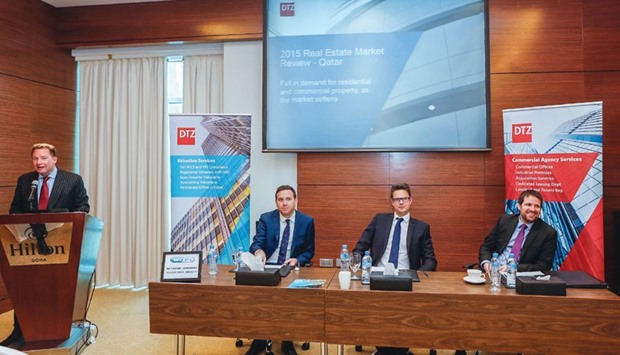
A DTZ Qatar official unveils the realty trends in Doha.