


A more than 6% collapse in Shanghai led Asian markets lower yesterday as a two-day global rally fuelled by stimulus talk came to an abrupt end following sharp losses in US and European markets while oil prices tanked again.
There had been a glimmer of hope that the worst start to a trading year on record may be easing, with a surge across all assets spurred by a European Central Bank pledge on Thursday to further ease monetary policy.
A report suggesting the Bank of Japan (BoJ) was considering similar moves fanned the optimism, with crude surging about 15% over the two days and equities seeing blistering gains.
But analysts said the euphoria subsided as the realisation set in that the oil market is far too oversupplied for its weak demand, and with China’s economy continuing to struggle.
“Obviously investors are working through some potentially difficult issues in their minds about the state of the world economy,” John Carey, a Boston-based fund manager at Pioneer Investment Management, told Bloomberg News.
“It might be a while before we emerge from this period of uncertainty.”
Shanghai, which has already this year lost about 17%, slumped 6.4% by close yesterday.
The slump came despite the People’s Bank of China pumping $67bn into the money market in a bid to ease tight liquidity ahead of the Lunar New Year holiday. The injection was the largest since 2013, Bloomberg News reported.
But analysts said dealers took their cue from losses in New York, where all three main indexes lost more than 1%.
“Some investors have no desire to continue fighting before the upcoming holiday, so the market is quite vulnerable to external factors. Once the drop deepened, investors went panic-selling,” Zheshang Securities analyst Zhang Yanbing told AFP.
Also taking a painful hit was Tokyo’s Nikkei, which lost 2.4%, while Hong Kong was 2.5% lower. Seoul closed 1.2% lower while there were also hefty losses in Manila and Taipei. Sydney was closed for a public holiday.
With markets from Asia to the Americas seeing trillions of dollars wiped off their valuations since then, experts are keen to find out policymakers’ current views.
The BoJ faces more pressure to act as the Japanese economy struggles to get back on track, with the government’s promised jump in inflation still a distant prospect and economic growth still paltry.
On crude markets US benchmark West Texas Intermediate was 2.6% lower in afternoon Asian trade – extending the near 6% drop on Monday. Brent gave up 2.7% after diving more than 5% the previous day.
“The decline is not very surprising because oil fundamentals still remain weak,” said Daniel Ang, an analyst with Phillip Futures in Singapore.
“We’re looking at strong oversupply and not so outstanding demand,” he told AFP. “It is going to be very difficult to maintain higher prices.”
Analysts said the 15% jump in prices on Thursday and Friday was driven by a combination of speculative moves and expectations that the blizzard hitting the US East Coast would drive up demand for heating oil sharply.
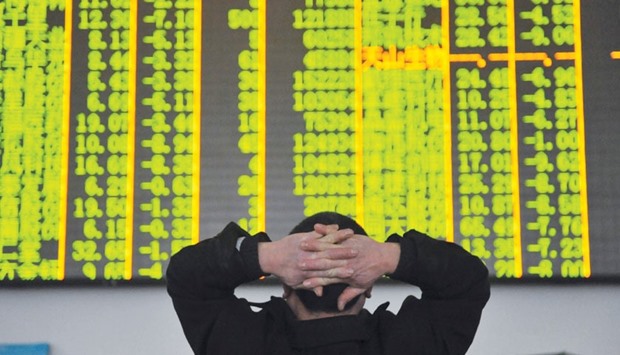
An investor looks at an electronic screen at a brokerage house in Hangzhou, Zhejiang province. Chinese shares plunged more than 6% to 14-month low yesterday after oil prices dropped again, reviving concerns about global growth and prompting a sell-off in the world’s equity markets.