


Come Saturday and it’s a wrap on one of the biggest solo exhibitions to hit Qatar. As the fascinating Luc Tuymans retrospective at Al Riwaq inches towards its closure, we offer insight into the celebrated figurative painter’s art and ideas, and give you new reasons to not miss this last chance to catch it.
With its sheer scale and range, let alone the content, Tuymans’ exhibition Intolerance elicits awe and wonder. Qatar Museums’ (QM) showcasing of his first solo show in the Gulf is a mega project that courses through 30 years of his work, featuring a long series of wall paintings and a new body of work, The Arena, created specifically for the show.
An in-depth, exhaustive catalogue titled Luc Tuymans: Intolerance – available at the venue, and also as a digital edition through musebooks.com – was published on occasion of the exhibition.
Put together by Curator Lynne Cooke and Tommy Simoens, this 465-page catalogue is a definitive companion to viewing the artist’s works as it offers interesting perspectives.
Nicholas Serota, Director of the Tate gallery, in his piece, says, “In any exhibition of his work there is a prevailing sense of menace and unease lying beneath a surface of innocence. Seemingly empty landscapes or rooms, apparently innocuous still-life compositions, blank portraits and figures caught in the flash of the photographer’s exposure generate a sense of disquiet that is only partially explained when we read the titles. Like the photographs of hillsides in Serbia or paddy fields in Cambodia, the full import becomes clear only after we have read the caption that tells us that these fields of cultivation were also fields of death.”
All through his career, Tuymans has addressed difficult topics such as colonialism, post-colonialism, and the propaganda symbols of Nazi Germany, and his signature painting style often references the techniques and visual qualities of film, reusing and refocusing images in ways that can simultaneously compel and distance the viewer.
Tuymans is an artist whose sharp observation of the contemporary world is deeply unsettling, feels Serota. “There is a beauty in his paintings that attracts and seduces our eye, while his images carry us into areas that provoke discomfort and unease,” writes Serota, “In this he reflects the artifice and uncertainties of the world in the early 21st century.”
Art critic and historian Jan Avgikos points out Tuymans’ remark that the power of painting lies in its ability to slow things down. “The reflective capacity of his work lays claim to the unremarkable aspects of daily life and bigger issues alike, as if remotely struggling for synthesis,” Avgikos writes, in his piece, “Resistance to the dizzying pace of contemporary culture takes many routes in his images. He takes up subjects and events of churning political significance, mediating figurative markers in such a way as to provoke unresolvable complexities. Whose history is it? How does media affect our consciousness? Can an image be owned?”
Tuymans’s paintings are always informed by a subtext that concerns imaging technologies, feels Avgikos. The “photographic,” a notational device that can suggest vague familiarity even when enigma prevails, is one of the ways we locate ourselves in his work, he says.
“Compared with generations of analogue culture, the digital era is characterised by unprecedented complexity, rampant uncertainty, and hypermobility,” Avgikos explains, “Today, it seems as if every other person uses a cellphone and billions are online. Digital media enable us to do things we couldn’t imagine 20 years ago. One result is that it is increasingly hard, if not nearly impossible, for many people to fully grasp what is going on. Tuymans’s art has always pivoted on this concern.”
Avgikos continues, “The cross-border operations of Tuymans’ paintings raise important questions about global power structures, politics, and economics. When Tuymans paints a picture, we understand that the image has been uploaded and downloaded many times over, stripped of context, retrofitted ad infinitum, and its meanings hinge on such operations.”
In his piece, Jenevive Nykolak points out, “The connection between the significance of a subject and its appearance has long been central to Tuymans’s enterprise. Again and again, he raises the potential unrecognisability of any representation and casts into doubt the ability of an image, recognised or not, to be truly adequate to its subject.”
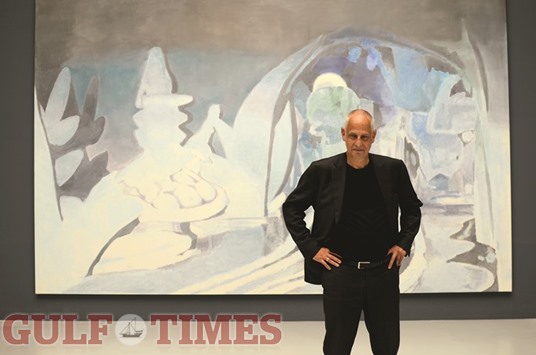
ENIGMATIC: Painter Luc Tuymans at Al Riwaq. Photo by Anand Holla