


Shale production may start to drop off in the United States in the first quarter of 2017, according to Vicki A Hollub, Oxy president and chief operating officer.
“Shale players had not stopped drilling when oil prices dropped. This is because there was a lot of optimism in the industry that prices will recover. So the drop off in activity has not really happened until the past four or five months… at least in the Permian Basin,” Hollub said in an exclusive interview with Gulf Times.
Bakken, Eagle Ford and Permian are the three main oil shale basins in the US.
She said the Bakken and Eagle Ford shale plays have started dropping first.
“They first plateaued and started declining production. Permian continued to grow production until just recently. And now we expect the Permian production to start plateauing and dropping off in the first quarter of next year,” points out Hollub who was on a brief tour of Qatar recently.
Oxy’s board of directors plans for Hollub to succeed Stephen I Chazen as CEO of Occidental after a thorough transition period, according to the company’s website.
She said the difference between shale and a lot of other projects around the world was that shale did not require a “lot of upfront capital” before the production start.
“So it is easy to shut down or ramp down activity quickly in the shale place,” Hollub points out.
(The global economic slowdown and increasing shale production are seen as the major causes for the falling oil prices.)
Asked whether it would be easier for shale producers to ramp down quickly given that they have raised significant debt for operations, the Oxy president said: “To get out, all they need to do is to shut down activity. And even if they go bankrupt, they will still be producing. You really can’t depend on what some people think that when a company fails, there is going to be no more production from that company. That’s not true. They will continue
to produce through bankruptcies.”
She said Oxy does have a shale portfolio, although Occidental Petroleum has traditionally been an enhanced oil recovery company.
In 2015, the company produced an average of about 110,000bpd from the shale play in the Permian Basin.
“It is important to note that while we have a portfolio of significant shale production, we are not a shale company. We have traditionally been an enhanced oil recovery company – that is what our expertise is in. That’s what we have done around the world.”
She emphasised that 2016 would be a “challenging year” for the industry.
“I expect the oil prices to be low this year, although I don’t know what the price would be. We don’t expect a recovery to any price like $60 or $70 this year. We actually expect this to continue well into 2017.
“The current difference between supply and demand of oil is going to cause prices to be lower (for longer) than many people had predicted,” Hollub said.
But by 2018, she said the oil prices might start improving.
“Because of the low level of investments in the industry and cancellation or postponement of many projects around the world, we think that by 2018, there will be an adjustment and that supply will be more in line with demand,” Hollub said.
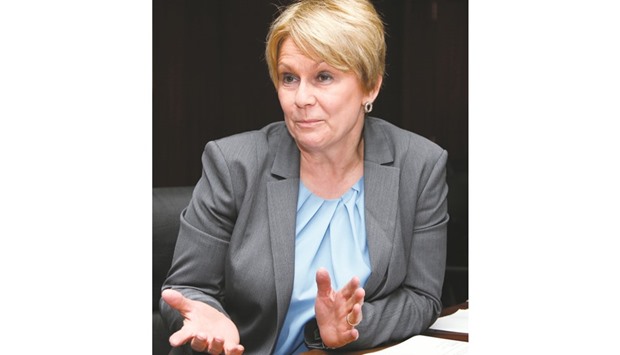
Oxy President and Chief Operating Officer Vicki A Hollub in an interview with Gulf Times in Doha.