


AFP/Tunis
 |
|
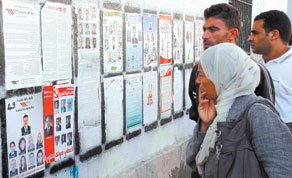
People look at electoral posters in the centre of Tunis yesterday |
“I am so happy to be voting tomorrow, to be able for the first time to exercise my choice. I get goose bumps just thinking about it,” Neda Kouki, 37, told AFP on the streets of Tunis, pulling up her sleeve and showing her forearm as proof.
Elections chief Kamel Jendoubi declared his ISIE polling commission “ready and confident”.
“We are happy, we are excited, we want the elections to succeed,” he told journalists with 18 hours to go before the first-ever democratic contest in a country where the outcome of polls used to be a foregone conclusion.
Jendoubi urged the current, interim government, however, not to interfere or risk jeopardising the election’s credibility—reacting to a statement by a foreign ministry official which he said created the impression the ministry rather than the ISIE was “running the election”.
“The only organisation that has the authority to issue information about voting is the high commission for elections and no-one else,” the elections chief said..
“If any representative of the government intervenes, that could jeopardise the credibility of this election.”
The Islamist Ennahda party is tipped to win the biggest bloc of ballots in today’s polls in which 7.2mn eligible voters are called to elect a 217-member assembly that will rewrite the constitution.
It will also have the loaded task of appointing an interim president and a caretaker government that will remain in place for the duration of the drafting process, expected to take a year.
“There are too many parties,” said Hishem Jmel, 47, an unemployed, undecided voter who stressed that casting his ballot was nevertheless “a duty, for a better future”.
Mohamed Ben Salah is one of the thousands of Tunisians who took to the streets in December and January in surprise, leaderless protests against corruption, poverty and unemployment that forced Ben Ali to flee to Saudi Arabia.
“I am 30 years old, but I have no work, no wife, no car, no house. I will be voting for freedom and for jobs,” he said.
The European Union observer mission said campaigning which ended on Friday had been calm and disciplined.
“There has not been excessive emotion, as is normal in countries in transition,” mission head Michael Gahler said.
“There is almost no chance of cheating or falsifying results, as the processes are transparent,” he added. “If everything goes as expected, we will have a credible result.”
ISIE official Mohamed Fadhel Mahfoudhn said all polling stations would have their ballot papers by the end of yesterday.
And Jendoubi added: “As far as security is concerned I think things are going the right way. There is a lot of vigilance.”
Ennahda had warned on Wednesday of a risk of vote rigging and vowed a fresh uprising if it detected fraud.
But party leader Rached Ghannouchi said at a final rally on Friday Ennahda “will recognise the results of the elections, we will congratulate the winners, no matter Ennahda’s score.”