


 |
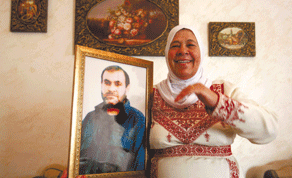
| The mother of Palestinian prisoner Adnan Maragha from the East Jerusalem neighbourhood of Silwan smiles yesterday as she holds a picture of her son, who is among the 1,027 Palestinian prisoners to be freed in exchange for captured Israeli soldier Gilad Shalit. Maragha has served 22 years of a life sentence |
The swap is expected to take place tomorrow and should bring to a close a saga that has obsessed Israelis for five years.
The gate of a prison in northern Israel swung open yesterday morning and three heavily guarded vehicles drove out carrying 15 Palestinian female inmates—some making V-for-victory signs—to another jail to await their release along with 12 other women and 450 male prisoners.
Israel’s Prison Service posted a list of the 477 prisoners due to go free, along with Shalit, in the first stage of the Egyptian and German-brokered deal, opening the way for anyone opposed to their release to file a legal appeal within 48 hours.
“Unless the Supreme Court intervenes, or someone in Gaza goes nuts, it appears the deal will go through in two days,” Yaakov Amidror, national security adviser for Israeli Prime Minister Benjamin Netanyahu, told Army Radio.
Those on the release roster included Palestinians jailed for attacks in which dozens of Israelis were killed. At least five prisoners have been in jail since their teens.
Gaza’s Hamas Islamist rulers prepared a heroes’ welcome for 295 of the prisoners due to be sent to the territory. Workmen hammered together an open-air stage and streets were decorated with Hamas and Palestinian flags.
“I am so happy I do not know what I will do, how will I hold him? It’s been 20 years,” said the mother of Naseem al-Kurd, a Hamas member who was sentenced in 1992 to eight life sentences for attacks that killed Israelis.
Workers readied an apartment for Kurd in Gaza, painting walls and repairing doors.
Shalit, a tank crewman captured in 2006 by militants who tunnelled into Israel from the fenced-off Gaza Strip and spirited him into the enclave, was expected to be handed over in Egypt’s adjacent Sinai desert and flown to Israel.
Israel, which withdrew troops and settlers from the Gaza Strip in 2005, tightened its blockade of the territory after Shalit was seized.
The repatriation of captured soldiers, alive or dead, has long been an emotionally charged issue for Israelis, many of whom have served in the military. But they also feel a sting over the release of convicted killers.
Photos of Shalit’s father, raising an Israeli flag over the roof of the family home, featured prominently in Israeli newspapers yesterday.
An opinion poll by Channel 10 TV showed the exchange was backed by two-thirds of Israelis. Shalit, now 25, was last seen, looking pale and thin, in a 2009 video shot by his captors.
One Israeli group opposed to the deal, the Almagor Terror Victims’ Association, said the exchange would lead to more violence and abduction attempts. The Supreme Court will hear its appeal today.
Gila Edri-Dekel, whose brother Sharon was abducted and killed by Palestinian militants in 1996, said her family has been in a state of angst since hearing that her brother’s killers were to be released in the swap.
“To see the number of prisoners released, to see his killers released, it is another punishment for my mother,” Edri-Dekel told Army Radio.
For Palestinians, prisoners held by Israel are revered fighters against occupation in a quest for a Palestinian state.
EU, Britain slam decisions on settlements
The EU accused Israel of riding roughshod through “obligations” surrounding peace efforts yesterday, by granting legal status to new and existing settlements in Palestinian territories.
European Union foreign affairs chief Catherine Ashton said decisions to proceed with 2,600 new housing units in the settlement of Givat HaMatos and to legalise housing in West Bank outposts were “unacceptable” and “run against road map obligations.”
“Settlements are illegal under international law. These decisions should be reversed,” she said in a statement released overnight Saturday. “The proposed constructions in Givat HaMatos are of particular concern as they would cut the geographic contiguity between Jerusalem and Bethlehem,” Ashton underlined.
British Foreign Secretary William Hague also voiced dismay over Israel’s plans.
“I am dismayed by the Israeli announcement on 14 October of a new settlement at Givat HaMatos,” Hague said in an official statement yesterday. “This provocative step, which further encloses East Jerusalem, is particularly disappointing.”
He added: “Settlements are not only illegal under international law, but also undermine the possibility of a two-state solution to the Israeli-Palestinian conflict and those working for a sustainable peace. I call again for these announcements to be revoked.”