


In case you have read Freakonomics: A Rogue Economist Explores the Hidden Side of Everything by Steven D Levitt and Stephen J Dubner, its upcoming discussion at the Qatar National Library (QNL) should be exhilarating. If you haven’t, it’s about time you did – there’s still nearly three weeks left for the discussion.
The Freakonomics book discussion event will be held on February 10, from 6.30pm to 8pm, at TV Lounge, HBKU Student Centre, Education City. “The authors, in this book, explore the hidden side of everything and reveal through exciting stories and deep sight that economics is a study of incentives, how people get what they want or need, especially when other people want or need the same thing,” says QNL’s note on the upcoming event.
A groundbreaking collaboration between Levitt, a University of Chicago economist, and Dubner, an award-winning author and journalist, Freakonomics explore the hidden side of everything: the inner workings of a crack gang; the truth about real-estate agents; the myths of campaign finance; the telltale marks of a cheating schoolteacher; and the secrets of the Klu Klux Klan.
“What unites all these stories is a belief that the modern world, despite a great deal of complexity and downright deceit, is not impenetrable, is not unknowable, and—if the right questions are asked—is even more intriguing than we think. All it takes is a new way of looking,” says a note on GoodReads about the book, “Freakonomics establishes this unconventional premise: If morality represents how we would like the world to work, then economics represents how it actually does work.”
Levitt argues that many apparent mysteries of everyday life need not be so mysterious: they could be illuminated and made even more fascinating by asking the right questions and drawing connections. For example, Levitt traces the drop in violent crime rates to a drop in violent criminals and, digging further, to the Roe vs Wade decision that preempted the existence of some people who would be born to poverty and hardship.
“They usually begin with a mountain of data and a simple question. Some of these questions concern life-and-death issues; others have an admittedly freakish quality. Thus the new field of study contained in this book: Freakonomics,” the GoodReads note points out.
The book’s introduction puts forth that statistics and subjects that normally seem dissimilar share commonalities when examined more closely and when the right questions are asked. To illustrate this point better, here are two insights from a Business Insider piece titled 10 lessons from Freakonomics that will blow your mind by Elizabeth Bogner, in which she remarks “With a tilt of the head, things can be seen clearly, the Freakonomic way.”
“Economics is mostly about incentives, which can backfire if you don’t understand how they work. One daycare learned the hard way...” it says and then elaborates, “Once upon a time, a daycare was plagued with late pickups. Notes were sent home, making the case for timely pickup in the name of respect for those who had to stay with the children, the children themselves. No change. Another note was sent home. A financial penalty for late pickups would start effective immediately. The result? Late pickups increased exponentially. Why? The guilt had been removed and the financial penalty was so low the late pick-up was now a parental perk that was accessible to most of the families. The lesson: incentives work, just not always as intended.”
“Incentives lead sumo wrestlers to throw matches, and teachers to cheat,” another summary of a Freakonomics lesson says, “Sumo wrestlers earn their living based on their ranking. The rankings are set by a series of matches that allow agreements between players to distribute higher standards of living to more wrestlers without sacrificing any individual ranking.
Teachers succeed or fail based on standardised tests that often have nothing to do with daily lessons. It isn’t hard to grasp the negative incentive of the potential loss in much needed financial support to their school, not to mention individual job loss or demotion. The conclusion a significant number of teachers arrived at was to drive up scores, even if it meant cheating. The lesson: All incentives have dark sides.
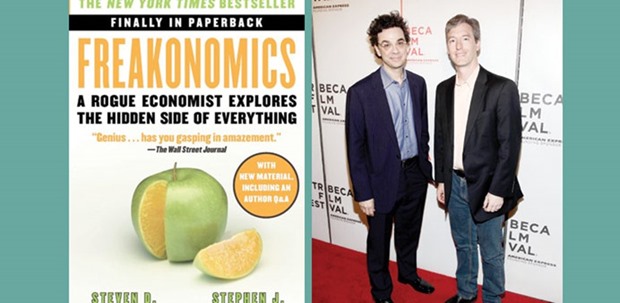
Picture right: Steven D Levitt, left, and Stephen J Dubner.