


 |
|
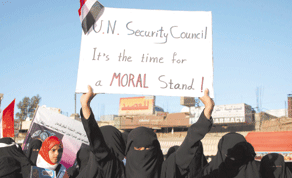
A protester holds up a placard during a demonstration to demand the resignation of President Ali Abdullah Saleh in Sanaa yesterday |
“Tell the international assembly that this is a peaceful revolution being suppressed by a barbaric authority,” chanted protesters who rallied in Sittin Street.
“O free people of this world, Ali (Abdullah Saleh) should be put on trial,” they chanted, demonstrating in a street protected by troops led by dissident General Ali Mohsen al-Ahmar, away from forces loyal to the embattled president.
A statement issued by the committee of the youth protest urged the UN Security Council to take Saleh to the International Criminal Court and to freeze his financial assets and those of his relatives.
It also urged an end to arms shipments to Saleh’s regime and to sever all links with his government.
The UN Security Council on Tuesday discussed the growing death toll in Yemen from protests against the president amid growing calls for a resolution on the crisis.
UN envoy to Yemen Jamal Benomar briefed a closed session of the 15-nation council on efforts to end strife which erupted in January and has since cost hundreds of lives.
The Gulf Co-operation Council (GCC) has proposed a peace plan under which Saleh would hand over power to a transitional administration. But the veteran leader, who has ruled for 33 years, has refused to sign the deal.
Britain and other European nations are drawing up a draft UN resolution which could be presented to the Security Council in the coming days. European diplomats say they hope Russia will not block the new effort.
The Security Council agreed a statement last month which stressed the GCC peace initiative. A resolution would have much greater diplomatic weight to pressure Saleh.
At least 861 people have been killed and 25,000 others wounded since Arab Spring-inspired mass protests against Saleh erupted in late January, according to a letter from the youth movement to the UN earlier this month.
The UN World Food Programme said yesterday that more Yemenis were going hungry because of rising food prices and severe fuel shortages brought about by political unrest.
“Rising food prices and political instability have left millions of people in Yemen hungry and vulnerable,” WFP executive director Josette Sheeran said in an e-mailed statement.
The months of violence and instability have pushed the already stressed Yemeni economy to the brink of collapse and forced millions of families further into poverty.
A recent WFP assessment indicated that the worst hit in this latest food crisis are children where malnutrition levels are the highest.
“Families, especially young children, are at greater risk of malnutrition,” the WFP statement said. “Even before the crisis, more than 50% of Yemeni children were chronically malnourished and more than 13% were acutely malnourished.”
The WFP programme is expanding its services to help feed some 3.5mn of the most vulnerable people in Yemen, many of whom have been displaced due to continuing conflicts in the north and south of the country.
The UN agency at present is feeding some 70,000 people displaced from Yemen’s southern provinces where government troops are battling to regain control of at least three cities that Al Qaeda linked militants overran in May.
They also help feed about half a million Yemenis displaced from the war-torn northern provinces where Houthi rebels have for years been battling government troops.