


Stocks, oil and emerging currencies all went into reverse yesterday as an early rally gave way to fear again, extending a rout that has sent global markets into a tailspin since the start of the year.
The day got off to a bright start, with Hong Kong, Tokyo, and Shanghai leading a broad advance across regional trading floors as investors picked up cheap assets following Wednesday’s bloodbath.
But the volatility that has marked the year so far returned with a vengeance in the afternoon, led by Chinese and Japanese equities.
Markets from Asia to the Americas have taken a hammering this year, chiefly hit by crashing oil prices and worries about the Chinese economy, a crucial driver of global growth.
“The ground right now is so unstable, and there’s so much anxiety,” Ayako Sera, a Tokyo-based market strategist at Sumitomo Mitsui Trust Bank, told Bloomberg News.
Shanghai, which had already dived around 16% this year, slumped more than 3% despite a huge injection of cash into financial markets by the People’s Bank of China (PBoC).
“The PBoC is trying to put liquidity back in the financial system after capital outflows and ahead of the lunar New Year holidays,” William Wong, head of sales trading at Shenwan Hongyuan Group Co in Hong Kong, said.
“Sentiment is volatile and it will take some time to restore investor confidence.”
Hong Kong was dragged by mainland stocks listed in the city, tumbling 1.5% in late trade, putting more pressure on the local dollar’s peg with the greenback.
Tokyo’s Nikkei lost 2.4%, Seoul shed 0.3% and Singapore was 1% off in the afternoon. There were also big losses in Wellington, Manila and Mumbai.
However, Sydney ended 0.5% up, closing before the heavy selling kicked off in the rest of Asia.
Following the trend for January, oil prices shifted into the red, and wallowing at 12-year lows as crude comes under pressure from a worldwide glut, weak demand, overproduction and a strong dollar.
As bargain-buying disappeared in the afternoon, US benchmark West Texas Intermediate – which fell below $27 briefly Wednesday – lost 0.8% to $28.12, while Brent shed 0.6% to $27.72. On currency markets, the dollar bounced back against emerging market currencies. The Australian dollar lost 0.2%, the Indian rupee slipped 0.1% and the Singapore dollar dipped 0.1%. The South Korean won was marginally lower and Thailand’s baht was flat.
However, the dollar retreated against the yen, which is considered a go-to unit in times of uncertainty and turmoil. The dollar slumped to a one-year low of 115.98 yen at one point Wednesday before recovering.
The Japanese unit was jolted higher after an aide to Prime Minister Shinzo Abe played down the chances the country’s central bank would ease monetary policy despite the recent market ructions.
Separately, Bank of Japan boss Haruhiko Kuroda also disappointed traders by refusing to indicate any alarm over the situation, adding to fears he could hold back from fresh stimulus measures for now.
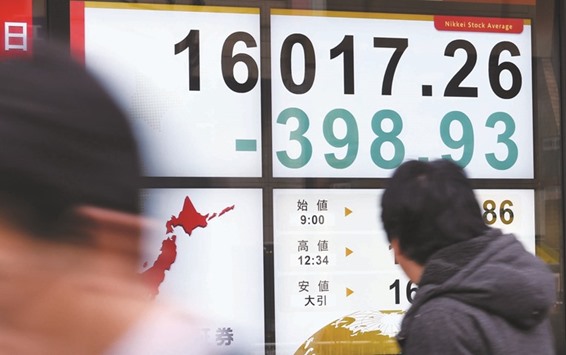
A pedestrian looks at an electronic monitor showing the closing rate of the Tokyo Stock Exchange. Japanese shares tumbled 2.43% or 398.93 points to close at 16,017.26 yesterday, extending declines from the previous day, as a stronger yen hurt exporters.