


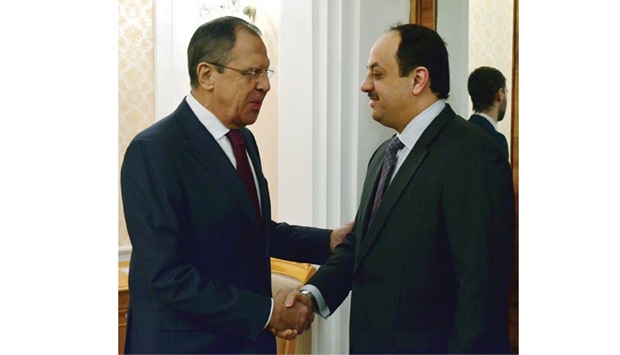
In an interview with Russia Today TV Channel (RT), HE al-Attiyah said: “Undoubtedly they are long-standing relations that need renewal from time to time through contacts. Recently, I had been in Moscow and met with my counterpart Sergei Lavrov to discuss bilateral relations and these contacts have culminated in the meeting between HH the Emir and the Russian president.”
Al-Attiyah said: “It is right that the visit has been postponed due to certain circumstances at that time. However, we are convinced that Russia is a big player in the region, and due to its relations with the Arab world, it could be an assisting factor in finding solutions to the crises the region in going through.”
He reaffirmed that “Qatar doesn’t build relations with states on the basis of speculation. We have our way of dealing with the states which we agree or differ with. That are negotiations, frankness and transparency, and that for us in Qatar is the shortest way to find solution to problems. I don’t conceal from you that we have been surprised by the Russian intervention in Syria in last September, and we had been keen that Russia would remain beside the Syrian people as we always hope to remain beside the Syrian people. However, we are convinced that Russia, which maintains a historical relation with the Arab countries, could find a solution to the Syrian crisis in which many innocent people have been victimised just because they called for their freedom and justice that has been lost for 50 years”.
Dr al-Attiyah stressed that military intervention has never been key to solving crisis. “Throughout history, we know that military intervention complicates matters rather than solves them. We have constants or matters agreed upon with Russia and we have no doubt that Russia supports a unified, Arab and civil Syria. These are the constants on which we agree now,” he said
Dr al-Attiyah explained that differences lie in the definition of Syrian people’s option. However, through dialogue with Russian officials and exchange of visits, we will come to the definition of the Syrian people’s option, adding: “We in Qatar have a definition for the Syrian people’s option that we may agree or differ on with the friends in Russia. Our definition is the departure of the regime which was the cause of terrorism as it worked as a magnet to attract terrorism on the one hand and on the other this regime worked to kill the hope of the youth who demonstrated peacefully. I will give you a simple example. Syrian youth Ghayyath Mattar took to the street at the outbreak of the revolution, if I am not mistaken on 8 September 2011, and began to distribute roses to the Syrian army. After torturing him for a day, his dead body was handed over to his family. Such stories should not be absent from our minds when we speak about the demands of the Syrian people, or leave the option for that people to decide.”
The Foreign Minister underlined that Qatar has spared no effort to convince the head of the Syrian regime to take positive steps towards his people. “Qatar effectively started on 27 March 2011 to have direct contacts on all levels with the head of the Syrian regime and there were contacts and visits on the highest level in an attempt to dissuade him from his way of dealing with the demonstrators and to urge him make a few reforms which the Syrian people were, then, ready to accept,” Dr al-Attiyah said.
He noted that at the beginning of the revolution they were chanting the name of Bashar al-Assad as they wanted a few reforms and a little respect from the governors who oppressed the people in the Syrian cities. They demanded the reforms that Bashar al-Assad could have delivered, but regrettably he relied on the “security treatment of matters”.
The Foreign Minister said the Syrian regime embarrassed even its allies. “It embarrassed Iran and Hezbollah and is now trying to embarrass Russia to change its relations with the Arab world and it should pay attention to this issue because it is very serious. Our friends in Russia should be aware of this because the (regime) managed to change the views of Hezbollah and the look of the Arab people towards it as a resisting party. From the Arabs point of view it has become a hostile party to the people that helped it during its plight in 2006 and shared with Hezbollah their food and clothing. However, Qatar’s stand and principles have remained unchanged”.
The Foreign Minister strongly denied claims that Qatar aims at getting rid of a regime which was considered as an obstacle to a strategic project for the delivery of Qatari gas to Europe, adding that whoever adopts such an argument is not well briefed.
He stressed that “Qatar has no agenda and no interest in displacing regimes, noting that Qatar has intensely urged Bashar al-Assad to implement change but he has no culture of settlement towards his people this is what led to a disaster in Syria”.
On the existence of an agenda in Qatar, HE al-Attiyah stressed that this is not true as Qatar has the world’s largest floating LNG facility, noting that such claims are baseless.
On the Turkish-Russian relations, al-Attiyah said, the two countries share 100 years of excellent relations. Therefore, the two leaderships’ wisdom will not allow them to return to a hundred years ago. “We are counting a lot on this relationship in order to reach a Russian-Turkish solution”, he said, adding that the differences will be resolved based on both sides’ diplomacy and statesmanship.
As the biggest exporters of gas in the world, Russia and Qatar complement each other, are not competitors in energy sector and have a moral and legal duty to maintain gas supply to the global market, al-Attiyah said.
There should be a distinction between Qatar’s investments abroad and the question of influence, explained Dr al-Attiyah, referring to Qatar National Vision ( QNV) 2030, developed under the leadership of HH the Emir Sheikh Tamim bin Hamad al-Thani and aimed at advancing Qatari citizen and managing on a sustainable path for future generations thanks to investment bodies.
“We also have a legal and moral duty in international peace and security as Qatar is a member-state of the United Nations. Therefore, we always keep our principle initiative to resolve crisis by peaceful and diplomatic means and defuse crisis in the region which would affect us either directly or indirectly”, Dr al-Attiyah said.
“If the alternative is solar energy, we are ready to export solar energy as we are the richest country with solar energy in the world, Dr al-Attiyah added.
“Ensuring security, health, and education for all citizens is our main focus and we are working hard to diversify our sources”, Dr al-Attiyah added. He said the GCC has a system to develop the standard of living for the citizens in terms of services and education as well as upgrade their role through various projects that rely on diverse sources.