


Moldovan lawmakers has appointed the country’s third prime minister in less than a year, backing a man chosen by the president as a compromise candidate in the hopes of ending months of political deadlock.
The appointment of Pavel Filip, a member of the main pro-European coalition and a former IT and communications minister in the last government, followed the rejection of two previous candidates.
Moldova, Europe’s poorest country, has been without a proper government since a no-confidence vote toppled the previous administration in October, after the fraudulent disappearance of $1bn from the banking system.
The appointment took place amid chaotic scenes as angry protesters entered parliament and opposition legislators tried to block the vote.
Filip pledged his priority would be to ensure closer ties between the impoverished former Soviet state and the 28-nation European Union.
The vote itself took place in turmoil, with opposition politicians blocking access to the speaker’s podium to try to disrupt the process.
And the decision to choose Filip was met by a rally outside parliament that saw some five thousand protesters opposed to the vote gather to demand snap elections.
Several dozen managed to break through police lines and into the parliament building after the government was chosen, while police threw smoke grenades and used batons to try to disperse the demonstrators.
The EU called in a statement for “calm and restraint” and said that it would look to help the competing sides find a way out of the current crisis.
“We encourage all stakeholders in the country to engage in a dialogue and find, together, a way forward for the Republic of Moldova,” the EU said in a statement.
The last government, which was also pro-EU, lost a parliamentary confidence vote in October and so was dismissed.
With a new government in place, Moldova will hope to unlock further funding from overseas lenders, including the International Monetary Fund (IMF), that had been withheld in the wake of the banking scandal and the subsequent political crisis.
A sharp downtown in neighbouring Russia and drought have added to Moldova’s economic woes.
Underscoring the scale of the challenge Filip faces, the IMF in a report predicted the economy will have shrunk by 1.75% last year, although it did forecast a modest recovery in 2016.
“The people of Moldova don’t need a government that says pleasant things, but a government that solves their problems,” Filip said after the vote, as around 2,000 protesters stood outside parliament still demanding snap elections.
Moldova’s ruling elite has been the target of mass protests over the banking fraud, which saw the equivalent of one-eighth of Moldova’s gross domestic product disappear overseas.
Despite being touted as a compromise figure, opposition lawmakers resisted Filip’s appointment.
He has close ties to Vladimir Plahotniuc, one of Moldova’s richest but most unpopular men, who was a target of the protests.
Filip’s party originally wanted Plahotniuc as their candidate for prime minister, but President Nicolae Timofti refused to nominate him.
Opposition lawmakers, argued that Plahotniuc would be the real power behind the scenes.
The appointment follows the rise and fall of two prime ministers in the past year.
Chiril Gaburici resigned last June in the wake of accusations that he falsified his school diplomas, while his successor, Valeriu Strelet, was ousted by a no-confidence motion in October.
The IMF, which is talks with Moldova about new funding, has urged a clean-up of the financial sector.
Insiders say the $1bn banking fraud, a steady haemorraghing of money in unsupported loans which had been going on for years, reflects deep-seated corruption in Moldova and involved some degree of complicity from many of those in power.
“Long-standing deficiencies in identifying ultimate beneficial ownership of banks need to be urgently corrected,” the IMF said in its report.
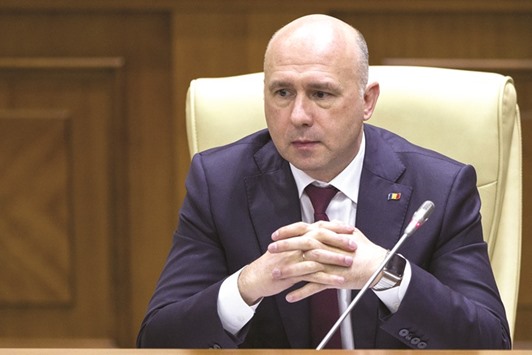
Filip: a compromise candidate.