


Chinese President Xi Jinping and Custodian of the Two Holy Mosques King Salman of Saudi Arabia yesterday inaugurated a joint-venture refinery, symbolising Beijing’s deepening involvement in the Middle East and Riyadh’s need for economic diversification.
The event took place in the Saudi capital on the second day of Xi’s first visit to the region. He later left for Cairo and will also travel to Iran.
The YASREF refinery, in Yanbu Industrial City on the Red Sea, is 62.5% held by Saudi oil giant Aramco, while China Petroleum & Chemical Corp (Sinopec) holds the remaining.
“YASREF represents both companies’ focus on driving downstream growth,” the refinery said in a statement.
Billboards on a highway outside the ceremony showed Xi and Salman waving against a backdrop of the refinery.
Saudi Arabia is China’s biggest global supplier of crude, and state-owned Saudi Aramco says expansion into refining and chemicals fits the kingdom’s goal of economic diversification.
The policy has been given added urgency by a plunge in the kingdom’s oil revenues.
YASREF is one of five joint-venture refineries in Saudi Arabia. Another four are overseas, including one in Fujian, China.
The YASREF refinery shipped its first diesel one year ago and has a capacity to refine 400,000 barrels of Arabian crude per day.
Saudi Aramco and Sinopec also signed a framework agreement on co-operation, reflecting confidence “in the potential opportunities we can create together,” said Saudi Aramco president Amin Nasser.
Sinopec’s strengths in refinery and chemical technology would support the kingdom’s drive to diversify its petroleum sector, said the company’s chairman Wang Yupu.
The ceremony, accompanied by a Chinese dragon and Arabian sword-dancing, took place in Riyadh at the King Abdullah Petroleum Studies and Research Center (KAPSARC).
King Salman separately inaugurated that facility, which focuses on energy research and policy.
Oil Minister Ali al-Naimi, who chairs KAPSARC’s board of trustees, told the gathering the centre would “contribute to the diversification and expansion of the Saudi economy”.
King Salman in December said he had ordered economic reforms to diversify sources of income and reduce the kingdom’s high dependence on oil.
Global crude prices have fallen from above $100 a barrel in early 2014 to below $28 yesterday.
To cope with a record budget deficit, the kingdom broke with its decades-old generous welfare system and raised fuel, electricity and other prices in its 2016 budget.
Government spending has also been cut, there is talk of a value-added tax in the tax-free nation, and state assets including Saudi Aramco could be privatised.
Trade between the Gulf nations and China, the world’s second-largest economy, has been growing.
Two-way commerce between China and Saudi Arabia alone reached $69.1bn in 2014, according to China’s official Xinhua news agency.
Although China depends on the Middle East for its oil supplies, it has long taken a low-profile approach to the region’s diplomatic and other disputes, only recently beginning to expand its role, especially in the Syrian crisis.
China, Gulf to speed up free trade talks
China and the oil-dependent Gulf states said yesterday they would accelerate talks on a free trade deal which has been under negotiation for more than a decade.
The announcement, in a joint statement, came during a visit to Saudi Arabia by Chinese President Xi Jinping.
“China and the GCC (Gulf Co-operation Council) have decided to accelerate the pace of negotiations, review the progress made and hold the next round of negotiations in the second half of February 2016,” the statement said.
“China and (the) GCC also commit themselves to work closely to conclude a comprehensive Free Trade Agreement within the year of 2016.”
China and the six-nation GCC announced in July 2004 the start of free trade talks.
Four years ago, then-Chinese premier Wen Jiabao called on both sides to “show political will to sign the agreement as soon as possible.”
Yesterday’s joint statement said negotiations resumed on Sunday, and on Tuesday “substantially concluded in principle the negotiations on trade in goods”.
Trade between the Gulf and China, the world’s second-largest economy, has been growing.
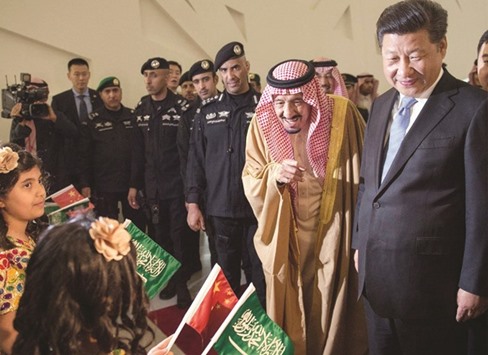
Custodian of the Two Holy Mosques King Salman bin Abdulaziz of Saudi Arabia and Chinese President Xi Jinping attending the inauguration ceremony of the Yanbu Aramco Sinopec Refining Company (YASREF) project yesterday in Riyadh.