


Former IAAF president Lamine Diack was responsible for the corruption at the ruling athletics body and his successor Sebastian Coe must also have been aware of the schemes and doping practices in Russia, according to an anticipated report.
The report, published and presented yesterday by an independent commission of the World Anti-Doping Agency (WADA), also said that “there was an evident lack of political appetite within the IAAF to confront Russia with the full extent of its known and suspected doping activities.”
The 89-page report named Russia “a doping haven” and said the IAAF had inadequate governance processes in place to prevent the corruption that occurred when athletes paid bribes to cover up positive doping tests.
It was presented by former WADA president Richard Pound as commission chairman, along with Canadian legal counsel Richard McLaren and Guenter Younger, head of the cyber-crime department of a German regional police office.
Coe was in attendance at the news conference in a Munich hotel, which attracted huge media attention, and French prosecutors who are also investigating were present as well.
Coe was a member of the decision-making IAAF council as a vice-president between 2007 and 2015 before succeeding Lamine Diack as president.
But Pound insisted that “I can’t think of anyone better than Coe to lead” and said the case offered “a fantastic opportunity” for the sport to clean up. Pound spoke of “institutional knowledge of troubles with Russia” and McLaren said the case was “beyond sporting corruption” and rather “criminal corruption.”
The report said that Lamine Diack created an inner circle “which filtered and funneled communications to and from senior IAAF staff, ultimately functioning as an informal illegitimate governance structure outside the formal IAAF governance structure ... when it came to dealing with anti-doping matters related to Russian track and field athletes.”
The circle included his sons, Papa Masada Diack and Khalil Diack, and his legal counsel Habib Cisse. Now resigned IAAF anti-doping department director Gabriel Dolle was also involved. The report added to a first from November after which Russia was suspended from the IAAF over widespread doping. Its athletes could miss competing at the summer Olympics in Rio de Janeiro and Russia’s anti-doping agency and Moscow laboratory were also suspended.
Last week, the IAAF ethics committee banned for life the former IAAF marketing consultant Papa Massata Diack; former IAAF treasurer and Russian athletics chief Valentin Balakhnichev; and former Russian coach Alexei Menikov. Dolle was banned for five years. Lamine Diack and his two sons, Cisse and Dolle are also subject of a criminal investigation by French authorities on corruption and covering up of positive doping tests. Papa Massata Diack is wanted by French authorities via Interpol. Yesterday’s report said Diack “was responsible for organizing and enabling the conspiracy and corruption that took place in the IAAF.
Interpol issues wanted notice for Diack’s son
Paris: Interpol said yesterday it has issued a wanted notice for Papa Massata Diack, son of Lamine Diack, the disgraced former president of world athletics’ governing body the IAAF.
“RED NOTICE: Papa Massata Diack, wanted by France on bribery, money-laundering & corruption charges,” the Lyon-based international police organisation said on its Twitter account. Diack’s profile and mug shot were added to the list of 332 other wanted people on Interpol’s online list.
Lamine Diack stood down as IAAF president in August before he was charged with corruption by French judges. Lamine Diack and his son, a former marketing consultant for the IAAF, are suspected of having made millions from bribes and other shady deals.
Diack junior was banned for life by the IAAF’s ethics commission on January 7. The commission found that the son, former Russia athletics chief Valentin Balakhnichev and former Russian walking coach Alexei Melnikov “conspired to extort what were in substance bribes from the athlete by acts of blackmail”.
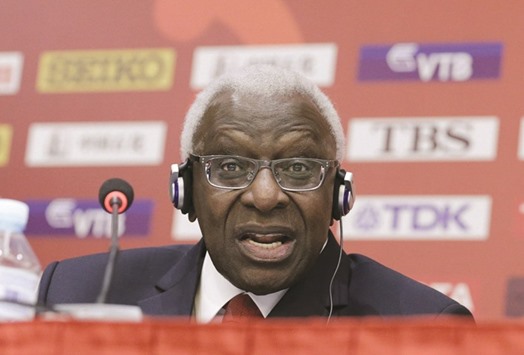
Lamine Diack