


 |
|
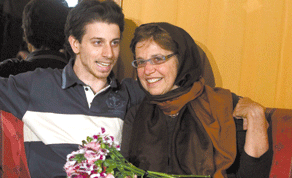
Americans Shane Bauer (right) and Josh Fattal sit with Swiss ambassador Livia Leu Agosti in Tehran’s Mehrabad airport before leaving for Oman yesterday |
Josh Fattal and Shane Bauer, who were arrested while hiking along the Iraq-Iran border in 2009 and denied being spies, flew out of Tehran airport late in the evening, the Swiss ambassador who represents US interests in Tehran told reporters.
The official Irna news agency said one of the men had spoken with his family before leaving Iran.
It said Fattal and Bauer were expected to go first to Oman, whose officials helped to secure their freedom.
“I am happy. They were my clients. We tried for nearly two years and gained the results we wanted,” the pair’s lawyer Masoud Shafie told reporters.
The Isna news agency quoted Shafie earlier as saying Oman had paid the bail.
The release was announced last week by President Mahmoud Ahmadinejad, who said it would be a humanitarian gesture before his annual trip to the UN General Assembly in New York.
In the event, the men’s departure on the eve of his speech to the assembly could hardly have been better for Ahmadinejad as he tries to improve his image with the US public.
Bauer and Fattal were arrested on July 31, 2009, near Iran’s border with Iraq along with a third American, Sarah Shourd. The trio, in their late 20s and early 30s, said they were on a hiking holiday.
Shourd was released on the same $500,000 bail a year ago and allowed to fly home, but the two men were sentenced to eight years in prison last month after a trial held behind closed doors.
Washington denied that any of the group were spies. Their supporters say no evidence against them was ever made public.
With no diplomatic relations between Washington and Tehran since the 1979 Islamic Revolution, several countries tried to resolve the impasse.
In addition to Oman, Iraqi President Jalal Talabani also helped to mediate, Iraqi officials said.
The Swiss embassy was also involved, but the ambassador, Livia Leu Agosti, was not allowed to enter Tehran’s Evin prison and had to wait in her car for the men’s release.
Shafie said the release had been delayed twice because a judge whose signature was required was away on vacation—another hint that Ahmadinejad’s rivals within the fractious ruling elite might have aimed to embarrass him.
Oman’s foreign ministry thanked Iranian Supreme Leader Ayatollah Ali Khamenei and the Iranian government for “responding with humanitarian considerations and to efforts of the sultanate’s government”, the Omani state news agency ONA reported.
The jailing of Bauer and Fattal sparked anger in Washington which already has deep differences with Tehran over its controversial nuclear programme, its refusal to recognise Israel and its support for militant groups across the Middle East.
US President Barack Obama regarded the jail terms handed down against the pair as “an abomination,” top White House diplomatic nominee Wendy Sherman told the US Senate Foreign Relations Committee earlier this month.
Shourd, a teacher, writer and women’s rights activist, met Bauer, a fluent Arabic-speaking freelance journalist, while helping to organise demonstrations in the US against the war in Iraq. The two moved to Damascus together in 2008.
Fattal, who grew up in Pennsylvania, is an environmentalist and teacher. He travelled in 2009 to Damascus, where he met Shourd and Bauer.
US military chief laments lack of contact with Tehran
US Chairman of the Joint Chiefs of Staff Admiral Mike Mullen regrets the lack of a “direct communication link” with Iran and fears it could lead to dangerous miscalculations.
Mullen, the highest-ranking US officer, expressed his concerns on Tuesday, a day after the Wall Street Journal reported that the Pentagon was considering establishing a military hotline with Tehran.
“We haven’t had a connection with Iran since 1979. Even in the darkest days of the Cold War, we had links to the Soviet Union,” Mullen told the Carnegie Endowment for International Peace. “We’re not talking to Iran so we don’t understand each other. If something happens, it’s virtually assured that we won’t get it right, that there will be miscalculations which would be extremely dangerous in that part of the world.”
The US has grown increasingly concerned about Iran’s alleged regional ambitions in recent years as Tehran has pressed ahead with its nuclear enrichment programme, which Washington fears is aimed at creating atomic weapons. Iran insists its nuclear programme is entirely peaceful, but its support for armed groups like Hamas and Hezbollah and its leaders’ harsh rhetoric on Israel have raised concerns in the West that it could plunge the region into turmoil.
The Wall Street Journal reported earlier this week that the US was especially worried about a fleet of speedboats that often challenge US and allied warships in the Gulf. The high-performance Iranian vessels are likely controlled by the Islamic Revolutionary Guard Corps, Tehran’s elite military force, and can be equipped with missiles.
In recent months, a British destroyer fired warning shots at one of these boats as it appeared to be preparing to ram the larger ship, and Iranian aircraft have also challenged US ships, the Journal said.
The US has not had diplomatic relations with Iran since its 1979 revolution, during which Islamists seized the US embassy in Tehran and held 52 diplomats hostage for more than a year.