


Heavy demand for the first edition of Hitler’s Mein Kampf to be printed in Germany since his death is taking its publisher by surprise, with orders received for almost four times the print run.
The two-volume political treatise, which was written between 1924 and 1926 and posits a global Jewish conspiracy, is regarded as one of the Nazis’ main propaganda tools.
It has been re-issued as a 2,000-page annotated version after its 70-year copyright expired.
The head of the Munich Institute for Contemporary History, which published the work, said that it had received orders for some 15,000 copies against a print run of just 4,000.
There had been requests for translations into Italian, French and English, and demand from Turkey, China, South Korea and Poland, Andreas Wirsching told a news conference yesterday.
The publication has unleashed fierce debate in Germany, a country still struggling with its Nazi past and its responsibility for the killing of more than 6mn Jews during the Holocaust.
Some German Jewish community leaders have said the “anti-Semitic diatribe” should remain banned.
But the institute, which added some 3,500 notes to the text, defended the publication.
“The edition unmasks Hitler’s false allegations, his whitewashing and outright lies,” Wirsching said.
The book became a bestseller in Germany in the 1930s, after Hitler had become chancellor, and sold 12mn copies by the time World War II ended in 1945.
It was translated into 18 languages, but after the war it was banned in Germany by the Allied occupying powers.
“The book is not only a historical source, it’s a symbol,” said Christian Hartmann, co-editor of the edition. “And we wanted to dismantle that symbol once and for all.”
The state of Bavaria was handed the copyright of the book in 1945, when the Allies gave it control of the main Nazi publishing house following Hitler’s defeat.
For 70 years, it refused to allow the inflammatory tract to be republished out of respect for victims of the Nazis and to prevent incitement of hatred.
But Mein Kampf – which means “My Struggle” – fell into the public domain on January 1.
Retailing at €59 ($65), the annotated version looks at key historical questions, including: “How were his theses conceived? What objectives did he have? And most important: which counterarguments do we have, given our knowledge today of the countless claims, lies and assertions of Hitler?”
Christian Hartmann, who led the editorial team for the annotated version, said the version could show a wider public how “aggressive the hate sermon” was.
Education Minister Johanna Wanka has argued that the annotated text should be introduced to all classrooms across Germany, saying it would serve to ensure that “Hitler’s comments do not remain unchallenged”.
“Pupils will have questions and it is only right that these can be addressed in classes,” she said.
Partly autobiographical, Mein Kampf outlines Hitler’s ideology that formed the basis for Nazism.
He wrote it in 1924 while he was imprisoned in Bavaria for treason after his failed Beer Hall Putsch.
The book set out two ideas that he put into practice as Germany’s leader going into World War II: annexing neighbouring countries to gain “Lebensraum”, or “living space”, for Germans, and his hatred of Jews, which led to the Holocaust.
Newspaper Tagesspiegel said the reprint serves as a historical documentation of the Nazi atrocities when “witnesses, victims or perpetrators are no longer around”.
“That cannot be stopped,” it added.
The Berliner Zeitung noted that the tract should have been banned for sedition during the Nazi era, and not now.
“Today, the book must be made available precisely for this reason,” the newspaper said, adding that it serves as an “arsenal” against anti-Semitism.
But opinion is divided among the Jewish community, with some leaders welcoming the new version and others slamming the reprints.
The President of the Germany’s Jewish Council, Josef Schuster, told broadcaster NDR that he welcomed the publication of the annotated version as it would serve to “undo the myth of this book” and show how “completely wrong and ridiculous Hitler’s theories and theses were”.
Charlotte Knobloch, leader of the Jewish community in Munich, however said she could not imagine seeing Mein Kampf in shop windows.
Ronald Lauder, president of the World Jewish Congress, told AFP that not only would “Holocaust survivors be offended by the sale of the anti-Semitic work in bookstores again”, but that he also failed to see a need for a critical edition.
“Unlike other works that truly deserve to be republished as annotated editions, Mein Kampf does not,” he said, arguing that academics and historians already have easy access to the text.
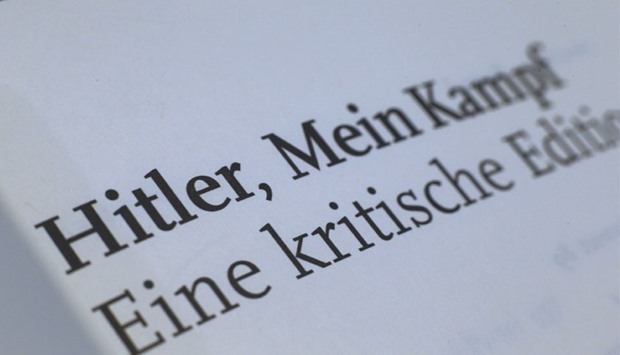
The title page of the book Hitler, Mein Kampf. A Critical Edition.