


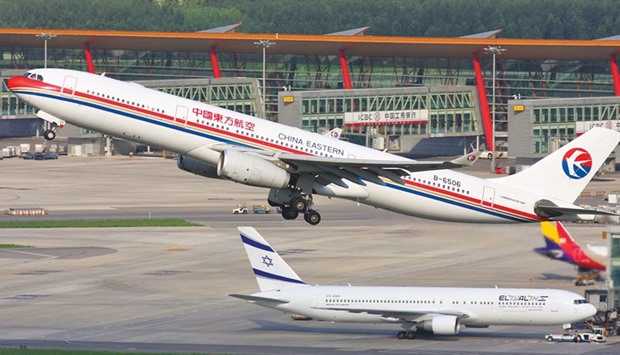
“The recent renminbi weakness has put some pressure on us, but we have been very actively optimising our debt structure,” James Wang, a spokesman for the Shanghai-based carrier, said in a telephone interview yesterday. “In the near term we will further reduce the size of our dollar-denominated debt and its proportion to our overall debt.” Global financial markets have been rocked as the Chinese yuan has fallen 1.42% against the dollar and a stock sell-off sparked in part by worries about China’s economy has spread around the world. The volatility to start the year has fanned worries about the Chinese government’s ability to manage reform as growth slows in the world’s second-largest economy.
Yesterday, the People’s Bank of China set the yuan’s daily fixing at 6.5636 per dollar, the first stronger fixing relative to the previous day’s close in nearly two weeks. The currency is not allowed to move more than 2% on either side of the fixing. Mainland stock markets also rallied yesterday after the securities regulator suspended a controversial new circuit- breaker system that analysts said had exacerbated volatility. China Eastern Air extended gains yesterday afternoon in Shanghai, rising by as much as 9%, while paring its losses to as little as 1.3% in Hong Kong. The Shanghai Composite Index was up 2.3% as of 2:26 pm, while the Hang Seng Index was up 0.8%.
“Presently, the economic situation doesn’t seem to have too adverse an impact on the airline,” Wang said. “The market may be overly concerned about the renminbi’s impact. We don’t think the renminbi will see further steep or quick declines.” Weak global oil prices generally are beneficial for airlines in the longer term, and the volatility in the stock market doesn’t closely reflect China’s economic strength, he added.
The Shanghai-based carrier said on January 4 it had repaid $1bn in dollar-denominated debt to reduce its vulnerability to exchange-rate fluctuations. On December 30, the company finished issuing a tranche of short-term commercial paper worth 1bn yuan ($152mn).
China Eastern currently has $1.39bn in dollar-denominated debt, nearly 17% of its total borrowings, and 6.94bn yuan in yuan debt, according to data compiled by Bloomberg. The airline said in its mid-year earnings statement that it had $6.5bn in dollar debt as of last June 30, and 19.6bn yuan in yuan debt.
China’s other large airlines also are likely to suffer from the weak yuan. Every 1% depreciation in the currency will negatively affect 2015 earnings by 8.2% for China Eastern, 6.4% for Air China and 7.6% for China Southern Airlines, Citigroup analysts led by Vivian Tao wrote in an August 11 note.
Meanwhile, other Chinese companies that have borrowed heavily in global dollar debt markets are increasingly planning early repayments of their dollar-denominated loans and bonds as the Chinese yuan’s weakness extends into the new year.
Bankers say the expected yuan depreciation over the next few years as US interest rates head higher and China’s take the opposite track will push more companies to follow suit to reduce exposure to dollar debt.
China SCE Property Holdings Limited said on Wednesday that it would redeem its $350mn senior note due 2017, while another real estate company, SUNAC China Holdings Limited, said it had completed the redemption of its dollar note due next year.
Under normal circumstances, non-investment-grade companies rarely redeem bonds early as they don’t always have easy access to refinancing, but that is changing as the yuan’s fall deepens and financing channels in China become available.
“Most of the companies we talked to are waiting for the call option dates to arrive to redeem their bonds. The yuan has weakened sharply and funding costs in China’s domestic market have become much cheaper now,” said a debt capital market (DCM) banker at an American bank in Hong Kong.
Dollar bond issuances by Chinese companies started to pick up in 2013, and many of them carried call options that usually allowed issuers to redeem bonds three years later, so there could soon be a flurry.
“Issuers started to contact us in September to ask about early redemptions of their dollar bonds, and such redemptions gradually came out since the end of last year,” said a DCM banker at a Chinese bank in Hong Kong.
“Even for companies that have sold dollar bonds without call options, many of them are consulting with us on how to redeem them ahead of due time,” the banker said. Chinese companies sold a total of $60.3bn worth of dollar-denominated bonds in 2015, more than six times the 2010 figure, Thomson Reuters data show.
The yuan posted a record yearly loss against the dollar last year and bearish bets on the currency hit a near six-year high as China’s central bank allowed the currency to depreciate at a faster pace, a Reuters poll showed on Thursday.
“Hedging cost for dollar debt is high as forward and option contracts are expensive now due to high volatility, so it makes sense to just adjust debt structure by cutting dollar debt exposure,” said a corporate treasurer at a Chinese state-owned enterprise in Hong Kong.
Smaller competitor Spring Airlines will also pay back some dollar debt this year before it’s due.
“We started to do this from 2013 and got more aggressive after the currency reform in August,” said Chen Ke, its chief financial officer.
The market consensus is for the yuan to fall further this year, though analysts are divided on how much. Kevin Lai, Daiwa’s Asia ex-Japan chief economist, expects it to hit 7.5 to the dollar by the end of the year.