


Three junior shadow ministers have resigned in protest at Jeremy Corbyn’s reshuffle in which two frontbenchers were sacked for disloyalty and a third was moved to clear the way for Labour to oppose the renewal of Trident nuclear weapons.
Jonathan Reynolds and Stephen Doughty stepped down from their roles after Pat McFadden was removed as shadow Europe minister for “serial disloyalty”, including what was seen as a coded attack on Corbyn’s response to the Paris terror attacks.
The third, Kevan Jones, resigned as a shadow defence minister after the Labour leader replaced his boss, Maria Eagle, who is pro-Trident, with the anti-Trident Emily Thornberry in the role of shadow defence secretary.
A Labour source said the leadership was relaxed about the response of MPs to the shakeup and did not believe there would be any significant resignations.
Corbyn avoided a mass shadow cabinet walkout of up to 10 MPs after he reached an agreement to keep Hilary Benn, the shadow foreign secretary, in his post in return for an end to public dissent over policy.
However, he decided to sack McFadden for what he saw as a variety of disloyal interventions, including a question to the prime minister in the House of Commons following the Paris atrocity.
McFadden asked David Cameron to reject the view that terrorist acts were always a response or a reaction to what the west did and to agree that such an approach risked infantilising terrorists when the truth was that they were adults who were entirely responsible for their actions.
This was seen by Corbyn’s team as an implicit attack on the leader and was interpreted as such in the media at the time.
In a letter to the Labour leader, Reynolds said he had enjoyed his role as shadow rail minister but wanted to exercise more freedom to express his views on the future direction of the party.
He also cited the sacking of McFadden as the trigger for stepping down, saying the news had “pushed him over the edge”. Reynolds’s letter said he could not “in good conscience endorse the world view of the Stop the War Coalition” - the anti-war group chaired until September by Corbyn and which the Labour leader praised in December as “one of the most important democratic campaigns of modern times”.
Doughty, a shadow foreign affairs minister, who had raised objections with Corbyn about Stop the War’s reaction to the Paris attacks in November, announced his resignation on live television.
He told the BBC’s Daily Politics: “Fundamentally, I agree with everything that Pat McFadden said about terrorism and national security and not being seen to develop a narrative that somehow it’s the west that is responsible. I have to look at my own conscience in that situation. It’s only the honourable thing for me to do to also tender my resignation.”
Jones told the BBC’s The World at One that shifting Eagle was a mistake in terms of Labour’s credibility on defence.
He also criticised the way the reshuffle was carried out, saying: “There’s nothing straightforward or honest about what’s gone on in the last 48 hours.”
Jones claimed Eagle was not happy about being moved, despite Labour leadership sources claiming she was pleased with the new job and had always wanted to cover the culture brief.
Meanwhile, Benn has denied he is being silenced by Corbyn. Corbyn considered whether to sack Benn, but Labour sources said the two came to an agreement on Tuesday night that there would be no repeat of the situation in which the shadow foreign secretary argued for intervention in Syria from the frontbench while the leader made the case against.
Corbyn will in future govern the direction of foreign policy and Benn would have to speak from the backbenches in the event of any disagreement.
Benn told Sky News: “I haven’t been muzzled. I’m going to be carrying on doing my job exactly as before, which is speaking for Labour on foreign policy, supporting Corbyn and campaigning really hard to get Labour elected at the next general election.”
Corbyn made the key moves in his reshuffle on Tuesday night, more than 30 hours after it began on Monday.
His biggest move was replacing Eagle with his ally Thornberry, clearing the way for a Labour policy change to oppose the renewal of the Trident nuclear weapons system when there is a vote this year.
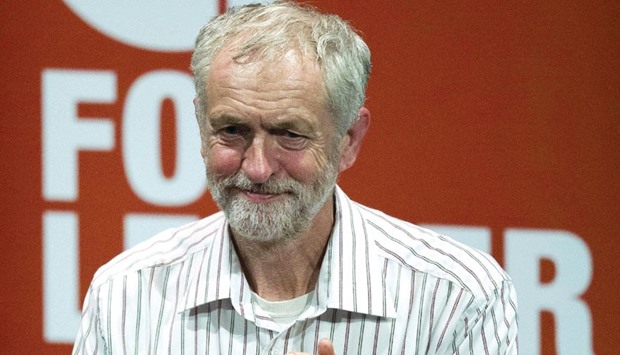
In this file picture taken on September 2, 2015, British Labour Party leadership candidate Jeremy Corbyn applauds after addressing a rally in Chelmsford, east of London, on September 2, 2015. From the leftist favourite Jeremy Corbyn in pole position to the more centrist Liz Kendall at the back, four candidates are vying for top spot in the race to lead Britain’s main opposition Labour Party.