


Venezuela’s opposition took control of the legislature for the first time in 17 years yesterday but President Nicolas Maduro bid to outmanoeuvre them by seizing control of the central bank.
Opposition lawmakers wearing caps in the red, yellow and blue national colours crossed a line of police guards as they arrived for a tense swearing-in ceremony at the National Assembly.
They have vowed to bring change to the oil-rich but crisis-hit nation.
Facing the toughest challenge yet to his authority, Maduro has moved to chip away at their majority which they want to use to force him from office.
But he ordered security forces to make sure the lawmakers were not prevented from getting into the assembly for yesterday’s session, which got under way in the early afternoon.
The tense political struggle has raised fears of fresh unrest after street violence sparked by anti-government protests left 43 people dead in 2014.
Maduro has vowed to defend the welfare programmes of his socialist “revolution” launched by his late predecessor Hugo Chavez who came to power in 1999.
“On January 5, a day of peace, let the bourgeois parliament be established and let the revolutionaries get to work to rectify, to fight and to build,” Maduro said in a televised address.
Yesterday he published a presidential decree that gives him, instead of the assembly, the power to appoint the heads of Venezuela’s central bank. That snatches away the opposition’s power to influence monetary policy, one of the key levers for change in the current economic crisis.
Maduro also said he would try to get the assembly to support a new economic emergency plan, setting up yet another political clash.
The broad opposition coalition MUD, which includes leading conservative parties, won a majority in the assembly in elections on December 6 - the first such opposition majority since 1999.
Maduro has appointed new judges to the Supreme Court, which has granted his request to order the suspension of three incoming lawmakers over alleged voting fraud.
The opposition wants to take constitutional steps to get rid of Maduro, but would be much less likely to succeed without a supermajority.
The new opposition lawmakers have appointed one of their senior figureheads, Henry Ramos Allup, as the new speaker in the assembly. He said his side had received assurances from the military that they would prevent “violent groups” from carrying out “acts of intimidation” around the assembly.
Defence Minister Vladimir Padrino responded that the military should not be drawn into the controversy by those with “political” interests.
“The armed forces are not an institution for subverting constitutional order or disregarding democratic institutions, let alone for launching coups d’etat,” he wrote on Twitter.
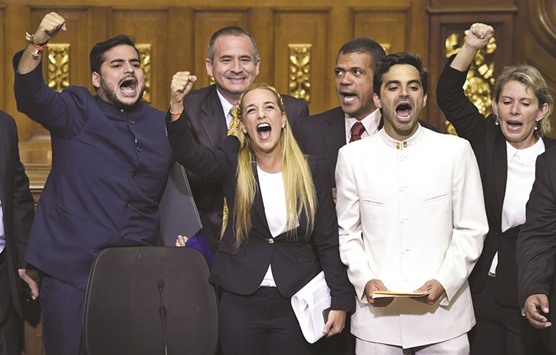
Lilian Tintori, wife of jailed opposition activist Leopoldo Lopez, cheers the opposition lawmakers in parliament in Caracas yesterday.