


The list of reasons for global investors to avoid Chinese shares in Hong Kong keeps getting longer.
Already beaten down by China’s economic slowdown, a falling yuan and vanishing top executives, so-called H shares now face a new threat: the impact of circuit breakers on the mainland. The Hang Seng China Enterprises Index fell as much as 4.4% on Monday after trading halts in Shanghai and Shenzhen spurred investors to shift sell orders to Hong Kong.
“Now it is up to Hong Kong to carry the burden, as traders who cannot sell their mainland portfolio will likely use Hong Kong,” said Hao Hong, chief China strategist at Bocom International Holdings Co in the city, who called both the boom and bust in mainland share prices last year. “Many traders are disenchanted.”
The H-share gauge plunged 19% in 2015, leading declines in Asia, as the Communist Party’s efforts to stem a rout in mainland equities had less impact across the border. The government’s sanction of a weakening yuan is exacerbating a deteriorating earnings outlook for Hong Kong dollar-priced shares as the economy slows. An anti-graft campaign that’s led to the disappearance or arrest of some of China’s most high- profile corporate executives is adding to foreign investor concerns.
The H-share gauge is valued at the biggest discount versus the MSCI All-Country World Index since 2003, according to data compiled by Bloomberg. The measure trades at 6.9 times earnings, ranking it among the cheapest gauges tracked by Bloomberg after indexes in Zambia, Lebanon, Kazakhstan and Laos.
Chinese shares in Hong Kong were already declining on Monday after data showed the nation’s manufacturing contracted for a fifth straight month. Losses escalated when a 5% drop by the CSI 300 Index triggered a 15-minute suspension, and deepened further as trading was halted on mainland exchanges for the rest of the day.
Trading in Industrial & Commercial Bank of China, the nation’s largest lender and the biggest dual-listed stock, illustrates the pattern. More than 16mn H shares changed hands in the minute that mainland stocks were halted for the day, or 6.2% of the entire day’s volume, data compiled by Bloomberg show. The stock touched its low of the day the same minute, falling as much as 4.5%, before paring its drop to 3.4% at the close.
ICBC retreated 0.9% in Hong Kong yesterday and gained 0.5% in Shanghai. State-controlled funds bought equities and the securities regulator signalled a selling ban on major investors will remain beyond this week’s expiration date, according to people familiar with the matter. The Hang Seng China Enterprises Index fell 1%, while the CSI 300 ended 0.3% higher after volatile trading.
Hong Kong’s bourse will introduce a volatility-control mechanism as soon as 2016 that would prevent an individual stock from moving 10% or more during a five-minute period, once a session. Stocks traded in the city aren’t currently subject to any daily price limits.
Monday wasn’t the first time investors have targeted Hong Kong amid shutdowns in mainland equities. The Hang Seng China Enterprises plunged as much as 9.4% on July 8, its biggest loss since 2008, as mainland officials allowed more than 1,400 companies to halt trading on the Shanghai and Shenzhen exchanges, locking sellers out of half the market.
Foreign banks were doubtful of the ability of China’s new system to calm price swings. Goldman Sachs Group said circuit breakers won’t notably reduce volatility given retail investors dominate turnover, while Citigroup said the mechanism is too conservative.
The measures play an important role in stabilising the market, and China will keep improving the system, China Securities Regulatory Commission spokesman Deng Ge said in a statement yesterday.
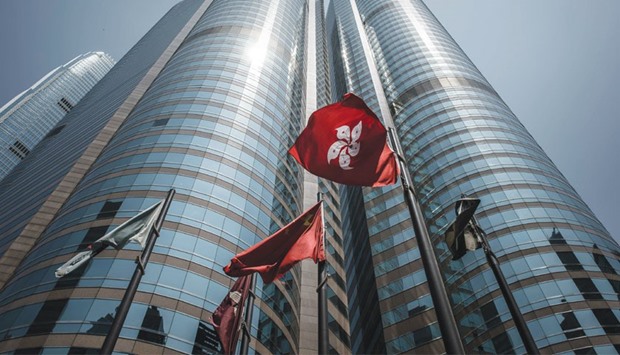
A frontal view of the Hong Kong Stock Exchange building. The bourse will introduce a volatility-control mechanism as soon as 2016 that would prevent an individual stock from moving 10% or more during a five-minute period, once a session.