


For years, Vladimir Putin used Vnesheconombank (VEB) to pay for “special projects,” from the Sochi Olympics to covert acquisitions in Ukraine to oligarch bailouts. Now, the state bank needs a rescue of its own and it could be the Kremlin’s costliest yet.
VEB faces $7.3bn in debt repayments over the next few years and effectively has only one source of significant funding - the state.
VEB was supposed to be the financial supercharger of the Russian president’s state-directed capitalism, using its government backing to raise billions at low rates on western markets and pumping them in to ventures the Kremlin wanted funded, some concealed from public view with code names like “Lily of the Valley.” Hit by Western sanctions last year, VEB has stopped new lending. The cost of its bailout could reach 1.3tn roubles ($18bn), according to several senior government officials, ballooning the budget deficit at a time when plunging oil prices are forcing spending cuts.
“The government can’t just leave it alone to face the problems caused by the financial and economic situation in the country, speaking directly, by various kinds of sanction pressures,” Prime Minister Dmitry Medvedev told a VEB board meeting discussing rescue options.
Over the past eight years, VEB came to epitomise Putin’s hybrid system that combined elements of market financing with tight Kremlin control, funding billions in industrial and infrastructure projects back in the days when oil prices were high and foreign credit was easy.
But US and EU sanctions imposed in 2014 over the Ukraine crisis cut off VEB’s access to international financial markets, leaving it without a source of cheap funding and facing as much as $16bn in foreign-currency debt just as the ruble began its plunge.
At the same time, falling oil prices accelerated Russia’s slide into recession, pushing many of VEB’s projects deeper into the red.
Putin earlier last month said many development agencies “have turned into garbage dumps for bad debts,” in what officials said was a clear reference to VEB. Losses on the bank’s huge catalog of Kremlin-mandated projects could reach 1.2tn roubles, according to the Finance Ministry, or nearly half the expected budget deficit for this year. “It’s an SPV,” or special-purpose vehicle, for pet projects, said Andrei Movchan, economist at the Carnegie Moscow Center. “It was an institution for saving bankrupt businesses. Alas, by taking on those risks, it went bankrupt itself.” VEB got its start under Soviet founder Vladimir Lenin as a bank to finance foreign trade. Putin overhauled it in 2007. Flush with cash from high oil prices, he pumped 180bn roubles (worth about $7.3bn at the time) in to boost capital and took over at chairman of the board a year later.
“Putin believed when he set up the state Corp that it would become a development institution,” like state-run lenders in Germany and Japan, Alexei Kudrin, who was finance minister at the time, said this month.
When the global financial crisis struck in 2008, VEB became Putin’s main tool for managing the shock. It got 1.25tn roubles (worth about $50bn at the time) from the government and central bank to shore up the plunging stock market, help failing banks and bail out tycoons who were facing the loss of their companies to foreign creditors.
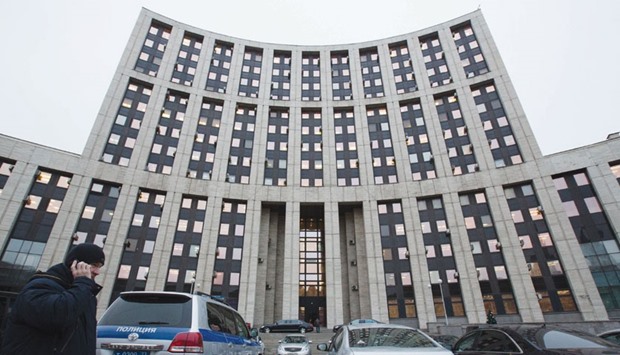
A pedestrian passes the headquarters of Vnesheconomobank in Moscow. Hit by Western sanctions last year, VEB has stopped new lending. The cost of its bailout could reach $18bn, according to senior government officials.