


Egypt is running out of ways to get a hold of dollars.
To buy the nation’s international bonds instead of Treasuries, investors are demanding the highest premium in more than two years, with the yield spread exceeding the average for emerging-market debt, according to data compiled by Bloomberg. The last time Egypt’s spread over Treasuries exceeded that of emerging markets, the yields made the sale of bonds unaffordable.
Nineteen months after the election of President Abdel Fattah al-Sisi, the former head of the military, Egypt is still unable to meet its economy’s hunger for dollars and is running out of resources to plug the gap. Cash aid from Gulf allies has dried up with the plunge in oil prices and exports are down. Tourism and foreign investment never recovered fully from the Tahrir Square uprising that toppled President Hosni Mubarak in 2011, after which surging borrowing costs effectively shut Egypt out of international markets.
“Egypt is very cost sensitive at a time when funding is not highly available for emerging-market issuers that have non investment-grade ratings,” said Lutz Roehmeyer, who oversees about €1bn ($1.1bn) of developing-nation debt as director of fund management at Landesbank Berlin Investment. Despite the rise in the nation’s spreads, “from our point of view, Egyptian debt is a bad investment as the huge risks are not compensated by high enough interest on the bonds,” he said.
After ending a five-year drought of international bond sales in June, officials delayed a second issuance slated for the fourth quarter because of rising borrowing costs. Egyptian authorities have burned through more than $20bn in aid received from Gulf allies since July 2013. The country lost more than half of its foreign reserves in the last five years to $16.4bn.
High yield demands undermined Egypt’s efforts to tap the international debt market in the aftermath of the Arab Spring. A plan announced in May 2011 to raise $1bn never materialised because officials weren’t able to secure a US guarantee for the bonds.
Saudi Arabia has agreed to invest 30bn riyals ($8bn) in Egypt through its public and sovereign funds to help Egypt’s economy overcome the foreign currency shortage that’s threatening to derail a nascent recovery, Egyptian Investment Minister Ashraf Salman said last month.
While Egyptian bonds spread have since declined 30 basis points to 539 at 1.21pm in Cairo on Wednesday, it’s still near the highest level since September 2013, according to JPMorgan Chase & Co indexes. The yield on the country’s 5.875% Eurobonds due 2025 has climbed almost 200 basis points since they were issued in June to 7.95%.
In 2015, the premium investors demand to hold dollar-denominated sovereign Egyptian bonds over similar Treasuries has surged 189 basis points. That compares with a 37 basis-point advance in the emerging-market average to 441.
For Ghana and Zambia, which carry the same B grade as Egypt at Fitch Ratings, government debt has spreads of almost a 1,000 basis points over Treasuries. That makes those bonds more attractive to hold than Egyptian long-term securities, Roehmeyer said.
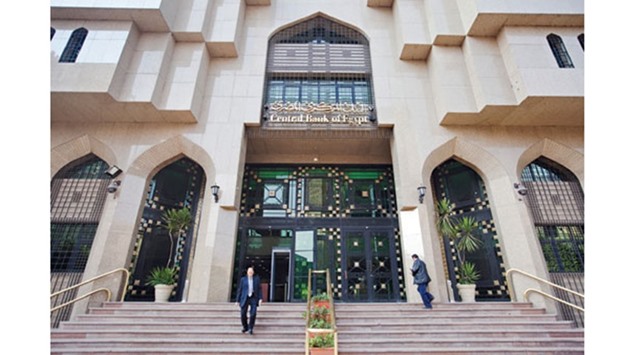
Pedestrians use the stairs outside Egypt’s central bank in Cairo (file). To buy the nation’s international bonds instead of Treasuries, investors are demanding the highest premium in more than two years, with the yield spread exceeding the average for emerging-market debt, according to data compiled by Bloomberg.