


Reuters/Tripoli
 |
|
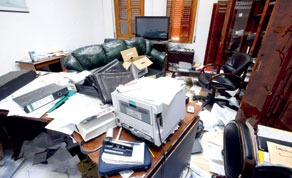
A view of the abandoned Libyan External Security office in Tripoli yesterday |
Documents found in the abandoned Tripoli office of Muammar Gaddafi’s intelligence chief indicate the US and British spy agencies helped the fallen strongman persecute Libyan dissidents, Human Rights Watch said yesterday.
The documents were uncovered by the human rights activist group in the abandoned offices of Libya’s former spy chief and foreign minister, Moussa Koussa.
The group said it uncovered hundreds of letters between the CIA, MI6 and Koussa, who is now in exile in London. Letters from the CIA began, “Dear Moussa,” and were signed informally with first names only by CIA officials, Human Rights Watch said.
The current military commander for Tripoli of Libya’s provisional government, Abdel Hakim Belhadj, was among those captured and sent to Libya by the CIA, Human Rights Watch said.
“Among the files we discovered at Moussa Koussa’s office is a fax from the CIA dated 2004 in which the CIA informs the Libyan government that they are in a position to capture and render Belhadj,” Human Rights Watch’s Peter Bouckaert, who was part of the group that found the stash, told Reuters.
“That operation actually took place. He was captured by the CIA in Asia and put on a secret flight back to Libya where he was interrogated and tortured by the Libyan security services.”
The files shed new light on the practice known as rendition, used by the US under former president George W Bush, in which the terrorism suspects were handed over to other countries for interrogation. Rights groups have criticised the US for sending these suspects to countries where they were likely to be tortured.
Belhadj has said that he was tortured by CIA agents before being transferred to Libya, where he says he was then tortured at Tripoli’s notorious Abu Salim prison.
Western intelligence services began co-operating with Libya after Gaddafi abandoned his programme to build unconventional weapons in 2004. But the files show his co-operation with the CIA and MI6 may have been more extensive than previously thought, analysts say.
The depth of the ties could anger officials in Libya’s provisional government—many of whom are long-term opponents of Gaddafi and are now responsible for charting a new path for Libya’s foreign relations.
Bouckaert showed Reuters photos of several documents on his computer and also photos of letters he said were from the CIA to Koussa and were signed, “Steve.” He also displayed photographs he said were of letters from MI6 giving Libyan intelligence information on Libyan dissidents in Britain.
“Our concern is that when these people were handed over to the Libyan security they were tortured and the CIA knew what would happen when they sent people like Abdel Hakim into the hands of the Libyan security services,” Bouckaert said.
In Washington, CIA spokeswoman Jennifer Youngblood, without commenting on any specific allegation or document, said: “It can’t come as a surprise that the Central Intelligence Agency works with foreign governments to help protect our country from terrorism and other deadly threats. That is exactly what we are expected to do.”
A US official, speaking on condition of anonymity, added:
“There are lots of countries willing to take terrorists off the street who want to kill Americans. That doesn’t mean US concerns about human rights are ignored in the process.”
“Let’s keep in mind the context here,” the official added. “By 2004, the US had successfully convinced the Libyan government to renounce its nuclear weapons programme and to help stop terrorists who were actively targeting Americans in the US and abroad.”
A British government spokesman said Britain did “not comment on intelligence matters.”
Envoy arrives to discuss UN role
A special envoy for UN Secretary General Ban Ki-moon arrived in Tripoli yesterday, as the international body and Libya’s new leaders stepped up efforts to bring order and democracy to the country. Ian Martin landed at a military airbase in the capital, after Ban said the world body was ready to assist in re-establishing security following the nearly seven-month uprising that ousted Muammar Gaddafi. “I am here now to discuss with the National Transitional Council how the UN can be most helpful in the future,” Martin told reporters on arrival. “I think the future leaders of Libya face a very big challenge, they have already shown the ways in which they are ready to tackle that challenge and it will be the commitment of the UN to assist them in any way they ask.” The victors extended until next weekend an ultimatum for the surrender of remaining loyalists to give time for negotiations to bear fruit, but moved troops towards Bani Walid, southeast of the capital, where they suspect Gaddafi may have taken refuge.