


Reuters/Washington
 |
|
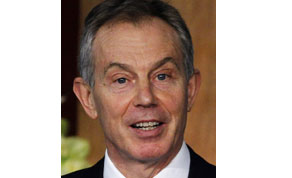
Blair: challenging mission |
As described by Western diplomats, the former British prime minister’s effort in part reflects a vacuum left by the US following the May resignation of former Senator George Mitchell as its special envoy for Middle East peace.
Blair’s specific task is to try to win agreement among the so-called Quartet—the European Union, Russia, the UN and the US—on a statement that might lure both sides back into peace talks after a gap of nearly a year.
If he fails, and if the Palestinians seek full membership during the UN General Assembly session that begins on September 19 over Israeli and US objections, the result could be a diplomatic snafu that leaves the two sides even farther apart.
Diplomats and analysts describe Blair’s challenge as Sisyphean and they question whether Israeli Prime Minister Benjamin Netanyahu or Palestinian President Mahmoud Abbas is genuinely interested in resuming peace negotiations for now.
Blair’s diplomacy to craft a consensus statement appears to be accelerating. In the past week he quietly met Netanyahu in Jerusalem and US Secretary of State Hillary Clinton and European Union foreign policy chief Catherine Ashton in Paris.
He plans to return to the region this weekend and is expected in the next few days to see Netanyahu again and to sit down with Palestinian officials.
The Quartet’s last high-level meeting on July 11 failed to yield agreement on a statement and diplomats cited four key disputes—the language on borders, referring to Israel as a Jewish state, the UN’s role and Jewish settlements.
One diplomat said he viewed Blair’s efforts “with sympathy and scepticism,” saying that it would be very difficult to bridge the gaps within the Quartet and between the two sides.
“There is a vacuum. Ultimately, I don’t think Tony Blair is going to fill it,” said the diplomat who spoke on condition of anonymity. “It’s probably too late to pull out a diplomatic solution to September.”
“September” has become shorthand for the diplomatic train wreck widely forecast this month when the Palestinians may seek full membership at the UN for a state of Palestine in the West Bank, the Gaza Strip and East Jerusalem, territories occupied by Israel in a 1967 war.
Daniel Kurtzer, a former US ambassador to Israel and to Egypt who is now at Princeton University, said President Barack Obama’s administration had searched for an Israeli-Palestinian strategy for two-and-a-half years without success.
“That partially reflects the fact that the person they thought was really going to grab hold of the policy and make it run, which was George Mitchell, didn’t, and since Mitchell’s departure, there really is no one who is identifiable as the go-to person,” Kurtzer said.
“There is a bit of outsourcing going on to someone like Tony Blair just to see if he can make something work,” he added. “If he can, the administration will glom on to it and if he can’t, the administration has not soiled its nest.”
The key issues to be resolved within the Quartet, and among the parties, include how any statement addresses the borders between Israel and a future Palestinian state, diplomats said.
In a May 19 speech, Obama gave the Palestinians a victory by saying “the borders of Israel and Palestine should be based on the 1967 lines with mutually agreed swaps.”
Israel, which hopes to hold on to some of the territory it seized in the 1967 war, dislikes the US suggestion that those borders should be the starting point for talks.
Another sticking point is referring to Israel as a Jewish state, a stance Palestinians say undermines a “right of return” for Palestinians who fled or were forced from their homes.
A senior US official said the US was leading the effort to bring the parties back into talks, describing Blair as trying to realise the vision laid out by Obama.
The official, who also requested anonymity, rejected any suggestion of a vacuum on the US side, pointing to the Obama speech as setting the framework for the current effort.
“We are leading this effort,” he said. “The president has given us this platform, everyone is working from that platform, and Blair, with all of his talents is a very important part of that.”
Jon Alterman of the Centre for Strategic and International Studies think tank said it would be very difficult to get the parties into talks because neither now seems to want them.
Asked why the Obama administration may have turned to Blair to do much of the current diplomatic work, he said it reflects in part Blair’s track record working with the Palestinians.