


Agencies/Tehran
 |
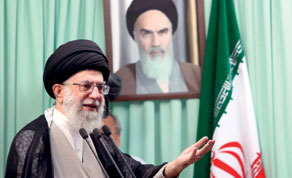
| Iran’s Supreme Leader Ayatollah Ali Khamenei delivers a speech in front of a portrait of the late founder of the Islamic Republic Ayatollah Khomenei during Eid prayers at Tehran University yesterday |
Iran’s supreme leader said yesterday a parliamentary election scheduled for early next year posed a potential risk to the country’s security and he called for national unity.
After the contested re-election of President Mahmoud Ahmadinejad in 2009 when huge protests were crushed by security forces, Iran’s ruling elite is keen for the voting next March to pass off without similar unrest or, as seems more likely, a low turnout from disaffected voters.
“We have an upcoming election at the end of the (Iranian) year. To some extent elections have always been a challenging issue for our country,” Ayatollah Ali Khamenei told worshippers at Eid prayers.
“Although, compared to elections in other countries and those so-called advanced countries where so much betrayal, malevolent acts, conflicts and even murder happen, thank God in our country it is not like that, but still it is a challenge,” he said in the televised address.
“We should be careful that this challenge does not hurt the country’s security,” the 72-year-old cleric added.
Khamenei fully endorsed Ahmadinejad’s re-election, which opposition supporters said was rigged. The government denied that, calling the post-election protests riots stirred up by Iran’s foreign enemies aiming to overturn the Islamic system.
Rights groups estimate around 100 people were killed in the unrest, a figure the government denies.
The losing reformist candidates in that election, Mehdi Karoubi and Mir Hossein Mousavi, have been under house arrest since February when they called for the first “Green Movement” opposition demonstrations for more than a year.
Their continued incarceration means many reformist candidates may choose to boycott the coming elections, a potential embarrassment for the Islamic Republic’s unique blend of democracy and clerical rule.
Khamenei last Saturday ordered a pardon for 100 people accused or convicted of “security-related” offences, including some involved in the post-election upheaval—the first sign of conciliation towards the opposition.
In his speech, the leader invoked events - popular revolts - in the Arab world which he has dubbed an “Islamic awakening” and said Iranians should put unity ahead of any grievances.
“The world is going through an important chapter in its history. We should be very cautious in this period and keep vigilant. If annoyances, ill wishes, discord and wickedness exist among ourselves ... we cannot carry out our important tasks. It is a fundamental necessity for our country.”
Any unrest around the elections would be new evidence of interference by Iran’s enemies, he said.
“You felt it at a close distance when our enemies want(ed) to use elections against our country’s security, you saw that. Everyone should be vigilant. The various authorities should guard the elections like a divine gift.”
Separately, Khamenei warned against the US taking “control” of the uprisings that have swept the Arab world, state television reported.
“The events currently taking place in Egypt, Tunisia, Yemen, Libya, Bahrain and elsewhere are key (events) for Muslim people,” the television’s website quoted Khamenei as saying.
“If the Muslim nations stand against those who interfere in their internal affairs, these nations will experience progress,” he told a group of officials and people.
“But if the world of oppression and world Zionism - including the oppressive regime of the US—take control (of the movements), the Muslim world will experience major problems for decades,” Khamenei said.
Tehran has supported the protests in all Arab countries except Syria, its main Arab ally. It has repeatedly criticised interference by the US and the West, particularly in Libya but also in Bahrain.
Iran-Saudi security is linked: Tehran
Iran believes Saudi Arabia’s security is linked to its own security, an Iranian foreign ministry official said yesterday, reacting to a Saudi allegation that Tehran was “targeting” the kingdom. “Iran has always wanted the stability, peace and progress of Saudi Arabia,” the Fars news agency quoted the unidentified official as saying. “The security of Saudi Arabia and Iran are linked and the Islamic Republic of Iran believes that the security of Saudi Arabia is like its own security,” the official said. Saudi Arabia’s Al Eqtissadiya daily on Monday quoted Interior Minister Prince Nayef bin Abdulaziz as saying that the kingdom, which has been shaken by a wave of bloody attacks by Al Qaeda, was still threatened by terrorism. He referred to “Iran and its targeting of the kingdom,” but did not elaborate. The Iranian official expressed “surprise” at such claims, saying they were “baseless and aimed at creating doubts among the countries of the region.”