


When Colombia announced this month that it had discovered the wreckage of the San Jose galleon, brimming with colonial-era bullion and studded with bronze cannons, President Juan Manuel Santos said it was an “enormous” find for “all of humanity.”
The 300-year-old shipwreck had been identified, he said, thanks to the work of world-class scientists, Colombia’s navy, and a mysterious researcher who Santos said “looks like Hemingway” and who gave him a previously unknown map.
But a US-based salvage outfit, called Sea Search Armada, has a more prosaic explanation for the discovery: it claims it found the San Jose more than 30 years ago and provided the co-ordinates to the government in 1982.
In 2007, after a lengthy legal battle, Colombia’s Supreme Court reaffirmed the rights of SSA, based in Bellevue, Wash., to half the riches on the ship not considered national patrimony.
The government insists it found the San Jose independently at a previously uncharted site. But as far as SSA is concerned, the “rediscovery” is a backdoor attempt to deny them their share.
Danilo Devis Pereira, the company’s lawyer in Colombia, said the administration’s December 5 announcement defies logic.
“Either there are two San Jose galleons or they found the same one a second time,” he said from his office in the coastal city of Barranquilla. “If it’s true that they found the shipwreck in another area then I’ll rip my arm off.”
SSA has been asking the administration to show them the site of the discovery, or share the co-ordinates, so they can determine if it’s the same galleon. So far that petition has been denied.
At stake is what’s thought to be the most valuable shipwreck in the Western Hemisphere. When the San Jose was sunk by the British Navy off the coast of Cartagena in 1708, it was said to be carrying six years’ worth of gold, silver, emeralds and other riches from the New World destined for Spain.
During a US court case in the 1990s, SSA estimated the cargo to be worth $4bn to $17bn.
However, SSA’s managing director, Jack Harbeston, said collapsing gold prices mean the treasure is probably worth a few billion less now.
The wreck is also at the centre of a more philosophical battle: Who should be the rightful owner of discoveries that are rich both in treasure and history?
Writing in Colombia’s El Tiempo newspaper, Irina Bokova, director general of the United Nations Educational, Scientific and Cultural Organisation, said shipwrecks are the equivalent of archaeological sites.
“It would bother everyone if tomb raiders in Egypt, willing to decapitate statues to sell them in pieces, were presented as brave explorers,” she wrote. “Why then are we so complacent with treasure hunters?”
Bokova said the galleon’s hull was stuffed with history “more valuable than its weight in gold” and that the ship’s rightful place was in a museum, not scattered around the world.
Finding shipwrecks is expensive. Harbeston said SSA spent about $11mn identifying the site of the San Jose.
And SSA has built a reputation around the world. It’s working with the Commonwealth of the Northern Mariana Islands to recover the Santa Margarita galleon.
“We know what we are doing and we are led in the field by a PhD archaeologist,” he said. “We know how to do this and we do it honestly.”
Despite Santos’ announcement, much is still unknown about the find. The government hasn’t revealed the exact site of the wreck or even the name of the company that helped find it. Santos said it was found through a public-private partnership and that those involved would be paid for their time and recover their expenses, but that the compensation would be less than 50% stipulated in the Supreme Court case.
In an interview with W Radio last week, Santos said the key to the breakthrough was a white-bearded foreigner who approached him at an embassy reception. The man had been studying the shipwreck “for 38 years,” Santos said, and had created a map based on “previously unknown” information, including wind patterns.
“He’s not a treasure hunter, he’s not after the money,” Santos said of the man. “He has an affinity for history, archeology and culture.”
After careful study, the government decided the claim had merit. It was that map, along with the government’s long and tedious work, that led to the find, Santos said.
Devis said it was “absurd” to think that someone could have pegged the San Jose’s location just by reading dusty books.
“The only way they found the shipwreck was using our co-ordinates as a starting point,” he said.
The company sent a letter to the ministry of culture reminding it that on March 18, 1982, it provided a location to the government along with a note stating that the wreckage was “in that immediate vicinity.”
The government has said nothing was found at the SSA location, but the company claims the administration is moving the goal posts.
“As we clearly stated, the site of the shipwreck is not at the co-ordinates we provided but within that immediate vicinity,” the company wrote.
Devis said that at the time, in the 1980s, technical limitations allowed salvage companies to provide locations with a margin of error - but the margin was never stipulated in Colombian law.
He said SSA has since tried to engage the administration in a discussion about what “immediate vicinity” might mean to no avail.
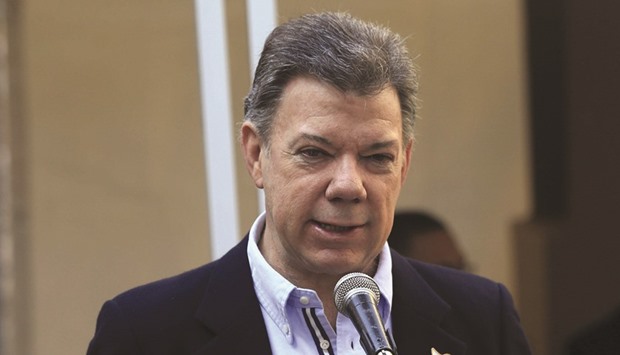
Juan Manuel Santos