


Pro-government supporters held demonstrations country-wide in Burundi yesterday against plans by the African Union (AU) to deploy 5,000 peacekeepers to the country.
The AU announced last week that it plans to use the peacekeeping mission to avert further violence in the country, where protesters have been rebelling against President Pierre Nkurunziza’s third term in office.
The demonstrations on Saturday took place in major towns in 18 provinces, with demonstrators at a march in Bujumbura holding banners saying, “We are against the deployment of AU troops into Burundi” and “There is no war or genocide to justify the deployment of AU troops.”
“No foreign soldier will step his foot on Burundian territory without the authorization of the government,” Vice President Gaston Sindimwo said at the Bujumbura march attended by hundreds.
“We warn politicians who are behind insecurity in Burundi that we will not tolerate them. We will continue to fight against criminals,” said Sindimwo.
The initial AU deployment, which will be for six months, “is mandated to prevent any deterioration of the security situation” and contribute “to the protection of civilian populations under imminent threat,” the Union said.
If Burundi does not accept the deployment within 96 hours, the peacekeepers could be sent in anyway against the government’s wishes, the AU Security Council said late Friday.
The AU said its Burundi mission is also intended to facilitate political moves to resolve the growing sectarian conflict between the Hutu and Tutsi populations.
Anyone who opposed the mission would face sanctions, the AU said. The union said it must now urgently seek financing for the mission.
There are growing concerns that Burundi could descend into another ethnic war between Hutus and Tutsis.
The UN said earlier this month that the country of 11mn was on the brink of another civil war. Some 250,000 people have already fled to neighbouring countries.
Nkurunziza triggered the conflict when he announced in April that he would run for a third term.
The most recent civil war in the impoverished country - which pitted the majority Hutus against the minority Tutsis, echoing the 1994 genocide of Tutsis and moderate Hutus in neighbouring Rwanda - ended only in 2005, leaving 300,000 people dead.
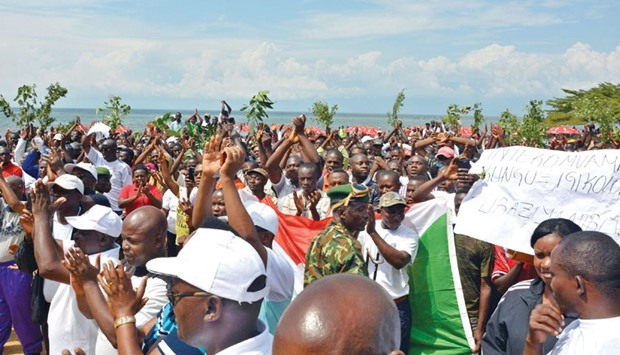
People gesture during a demonstration against the Republican Forces of Burundi (Forebu) on the beach of the Tanganyika Lake near the port of Bujumbura yesterday.