AFP/Ramallah
The Palestinian leadership sees “progress” in the European Union’s position on its plan to seek UN membership next month, a senior PLO official said yesterday.

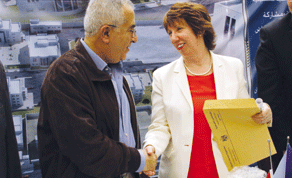
European Union High Representative for Foreign Affairs Catherine Ashton and Palestinian Prime Minister Salam Fayyad shake hands during the foundation stone ceremony of Jenin Governorate House during a visit to the West Bank City of Jenin yesterday
“There is progress in the European stance and a willingness to co-ordinate with the Palestinian leadership over the type of resolution we are looking for,” said PLO secretary general Yasser Abed Rabbo a day after President Mahmoud Abbas met in Ramallah with EU foreign policy chief Catherine Ashton.
Central to the talks in the West Bank town was the Palestinian plan to seek full membership in the UN when its General Assembly meets next month in New York despite Israeli and US opposition.
“We will inform them of every move and we won’t surprise them with anything,” Abed Rabbo said.
“We have seen progress in the European position which is demonstrated through the EU’s willingness to co-ordinate over the PLO’s steps in going to the UN,” he said.
Ashton arrived in the region on Saturday for a three-day visit aimed at pushing Israel and the Palestinians to resume direct negotiations, which have been on hold since last September in an intractable dispute over Jewish settlement building.
Abbas said yesterday that success in his UN bid would change the status of the Israeli-Palestinian conflict under international law.
“International recognition of our state based on the 1967 borders will make it a state under occupation. It will change the legal formula of our situation,” Abbas said in a joint interview with Jordan’s Al Dustur daily and Qatar’s Al Watan newspaper, without elaborating.
During talks with Abbas on Saturday evening, Ashton said the EU position would depend on the wording of the Palestinian proposal to be presented to UN chief Ban Ki-moon on September 20, Palestinian negotiator Saeb Erakat said.
Abbas told her that European support for the bid was crucial in order to safeguard the peace process, Erakat said.
“The president asked the EU to do everything to help us because the Palestinian bid is a way to preserve the peace process and the two-state solution and is based on international law and UN resolutions,” he said.
“We are facing an Israeli government which refuses to acknowledge the two-state solution based on the 1967 borders, and refuses to stop settlement activities so the international community must help and support us in this bid,” Erakat said.
Europe is currently divided over the Palestinian bid for UN membership, with Germany and Italy publicly opposed to the move, while Spain has said it will vote in favour; Britain and France are keeping their cards close to their chests.
Shortly before meeting Ashton, Abbas said that seeking UN membership was a direct result of the world’s failure to help the Palestinians secure their legal rights.
“We are going to the UN to ask for full membership for a Palestinian state. We wouldn’t be going if the international community had given us a solution which complied with international law—one based on the 1967 borders and a halt to settlement activity,” he said in a speech to religious leaders in Ramallah.
“But without that, we will go to the UN,” he said, while stressing that the bid would not prevent a “return to the negotiating table.”
“Regardless of the outcome at the UN, there are issues that cannot be solved without negotiating,” he said.
“Our decision does not seek to isolate Israel, nor to enter into a confrontation with the US. Our objective is to realise our dream of gaining international recognition for our Palestinian state at the UN with full sovereignty on the lands occupied in 1967.”
On Friday, Erakat urged both Brussels and Washington to support the Palestinian bid for UN membership.
“Maintaining the peace process and the principle of two states on the borders of June 1967 requires that the EU and the US support the application for full membership of Palestine in the UN,” he said.
Ashton was to meet later yesterday with Israeli Prime Minister Benjamin Netanyahu as well as with other top Israeli officials, and have breakfast with Foreign Minister Avigdor Lieberman early today before heading to Jordan.
Abed Rabbo said Ashton was expected to meet ministers from the Arab League monitoring committee in early September “to co-ordinate the Arab and European positions.”
Israeli envoy sees huge backing for initiative
Israel expects a massive vote for the Palestinians when they seek membership of the UN next month, Haaretz newspaper yesterday quoted Israel’s UN ambassador as saying. “Only a few countries will vote against the Palestinian initiative,” envoy Ron Prosor wrote in a classified cable to the foreign ministry, a copy of which was leaked to the newspaper. “The most that can be achieved is a group of states who will abstain or absent themselves during the vote,” he wrote, adding that his comments were based on more than 60 meetings with other UN envoys. The contents of Prosor’s message were confirmed to AFP by an Israeli official speaking on condition of anonymity. Quoting a senior foreign ministry source, the paper said that only five countries had told Israel they would vote against the Palestinian bid: the US, Germany, Italy, the Netherlands and the Czech Republic. The ministry is expecting 130 to 140 of the 193 UN member countries to endorse Palestinian membership—a majority of more than two thirds. This, however, is still not enough to ratify an application for UN membership, which must be approved by the Security Council where Washington has pledged to use its veto against the initiative. But the General Assembly could raise the Palestinians’ standing at the UN from its current observer status to that of a non-member state, Palestinian Foreign Minister Riyad al-Malki and other officials have said. That would allow them to become a full member of UN agencies such as the World Health Organisation, Unesco and Unicef.