


 |
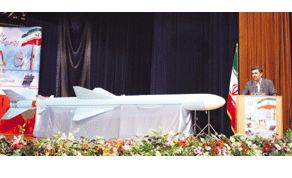
| A picture released by Iranian President Mahmoud Ahmadinejad’s official website shows him delivering his speech next to the Iranian-made Qader missile in Tehran yesterday |
“Qader (Able) missile, built by the capable hands of Iranian experts, is a marine cruise missile with a 200km range, possessing high destructive ability which can be used against coastal targets and warships,” the state television website reported.
Ahmadinejad also unveiled a torpedo system called Valfajr (The Dawn) to be used by submarines.
It has a payload of 220kg and can be used in shallow and deep water, the website said, adding that the unveiling ceremony was held at Malek Ashtar University in Tehran which has close links to the Revolutionary Guards, the elite military force.
Ahmadinejad said Iran’s arsenal was not aimed at any nations and would only be used to fend off possible aggressions.
“We do not want to use our military might to conquer lands and dominate humanity,” the official Irna news agency quoted him as saying in the unveiling ceremony.
“The best deterrence is that enemy does not dare aggression and must be so certain of a decisive response that it does not contemplate” an attack, he added.
“The enemy’s weaponry should be grounded at deployment point and not above Tehran’s sky,” he added.
Both weapons were “successfully tested,” the state television website said.
It quoted Defence Minister Brigadier General Ahmed Vahidi as saying that Iran was now “locally” producing the equipment and weapons systems for the navy.
Iran has increased in the past two years the development, testing and unveiling of new “indigenous” military equipment, including missiles.
These weapons are always accompanied by warnings against any potential aggressor, sometimes explicitly directed at the Islamic Republic’s arch foes, Israel and the US.
l A top UN atomic watchdog official last week toured Iranian nuclear sites, including ones where uranium is being enriched, a senior Iranian official was quoted as saying yesterday by Fars news agency.
Ali Asghar Soltanieh, Iran’s representative to the International Atomic Energy Agency, told Fars that the head of the IAEA’s nuclear safeguards division Herman Nackaerts visited the sites “last week for five days.”
Nackaerts was accompanied by his deputies, he said.
“They were taken to the Bushehr nuclear power plant, Fordow and Natanz enrichment facilities, to Isfahan nuclear installations, including the nuclear fuel rod-making plant, and to the Arak heavy water research facility and heavy water production plant,” Soltanieh was quoted as saying.
Tehran, which has been slapped with UN sanctions over its refusal to suspend nuclear enrichment, allowed the visit “to show the Islamic Republic’s goodwill,” he added.
The team was also taken to see advanced centrifuges, Soltanieh said, adding that at the end of the tour the delegation had talks with Iran’s atomic organisation chief Fereydoun Abbasi Davani.
Soltanieh said the visit was the result of meetings Abbasi Davani and Foreign Minister Ali Akbar Salehi had with IAEA chief Yukiya Amano in late June and mid-July in Vienna respectively.
“This once again shows our nation’s transparent co-operation with the IAEA and the international community,” Soltanieh said.
In February, Iran informed the IAEA that the Fordow plant was prepared to host centrifuges, and that it would become operational in the summer.
IAEA inspectors first visited the plant on October 25, 2009, after its disclosure by Iran to the agency triggered intense outrage in the West.
Iran’s uranium enrichment work, the most sensitive part of its controversial nuclear programme, is undertaken at the Natanz facility in central Iran which is visited regularly by UN nuclear inspectors.
Enriched uranium can be used to produce both the fuel for a nuclear reactor and the fissile material for an atomic warhead.
Iran is under four sets of UN Security Council sanctions over its refusal to suspend the uranium enrichment work, and officials in Tehran say they remain adamant to push ahead with the programme.