Agencies/Aden
Yemeni tribesmen killed four Islamist militants in the southern Abyan province yesterday, a day after a Yemeni jet bombed another southern location killing at least five militants.

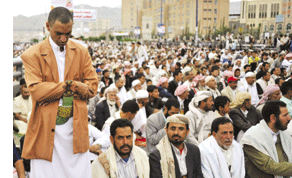
An anti-government protester prays during a demonstration to support the recently formed 143-member National Council in Sanaa yesterday
President Ali Abdullah Saleh’s government has lost control of some areas in the south after months of political turmoil and mass protests demanding an end to his three-decade-old-rule.
Yesterday, the militants were ambushed and killed in the southern town of Al Urqub, a security official said.
A day earlier, a Yemeni air strike hit the southern coastal town of Shaqra as well as two sites where militants had gathered in the town of Zinjibar, the official said. He was unable to give details of casualties in the Zinjibar operation.
Shaqra fell to the militants on Wednesday. It is the third town to be seized by militants following Jaar in Abyan province in March, and Zinjibar, the provincial coastal capital, in May.
Protesters and opposition parties suspect Saleh has deliberately loosened security to allow militants to act more freely, in an attempt to illustrate the dangers of a Yemen without the veteran leader.
Yemen’s army in July launched an offensive on militants suspected of having ties to Al Qaeda. Islamist militants, some possibly linked to Al Qaeda, may be exploiting a security vacuum as Saleh and his allies fight to stay in power.
Army units, backed by tribal fighters who have grown frustrated by the state’s inability to drive out the militants, have been struggling to retake Zinjibar, which lies east of a major shipping lane where some 3mn barrels of oil pass daily.
In a separate incident, 10 people—mostly women and children—were injured in an explosion at a clothes market in Al Qatn in the southern Hadramout province on Thursday, which targeted an army officer and his family, a security official said.
Witnesses said they saw a man throwing a hand grenade and later fleeing in a car. The officer and his family survived unhurt, the official said.
Saleh, in power since 1978, said on Tuesday he would soon return home from Saudi Arabia where he is recovering from a June assassination attempt in which he was wounded.
Popular protests against Saleh erupted during uprisings that ousted the presidents of Tunisia and Egypt this year, but the Yemeni leader has clung to power, defying international pressure and three times backing out of a Gulf-brokered transition deal.
Anti-government protesters took to the streets in several provinces yesterday to support the recent formation of the opposition National Council, which aims to create a unified front for the uprising.
The 143-member National Council, composed of a wide spectrum of anti-regime groups, was declared late Wednesday and aims to take over transitional power and increase the pressure on Saleh to step down.
Protesters in Sanaa praised the National Council as a success for the opposition and chanted slogans scorning the son of president Saleh who commands the Republican Guards that has been at the forefront of crushing the revolution since last February.
The protesters called on the international community to welcome and co-operate with the national council.
Yemen’s Deputy Minister of Information Abdu al-Janadi accused the opposition in a press conference on Thursday of “exploiting and hijacking the youth uprising.”
The first official meeting of the newly formed national council is expected to take place today.